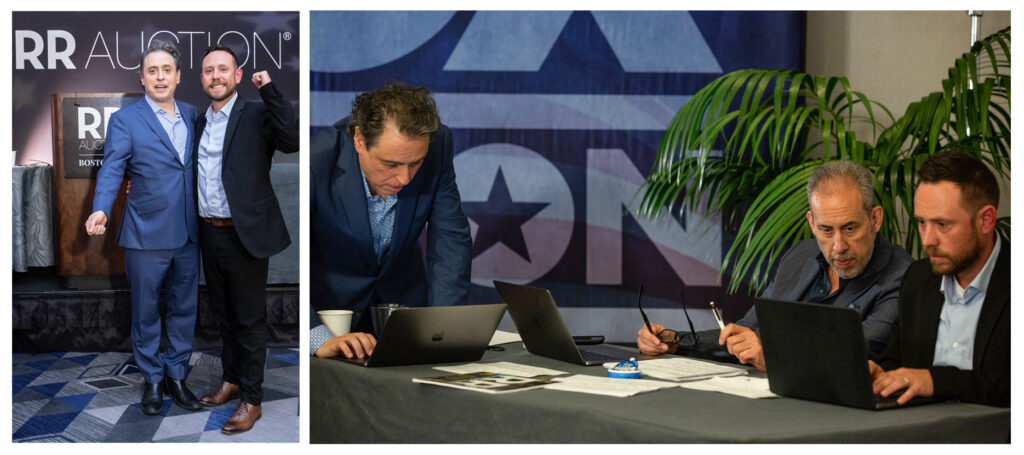
Bobby Livingston on the History of RR Auction
by Bobby Livingston, Executive Vice President & Principal, RR Auction
I went looking for catalog number one.
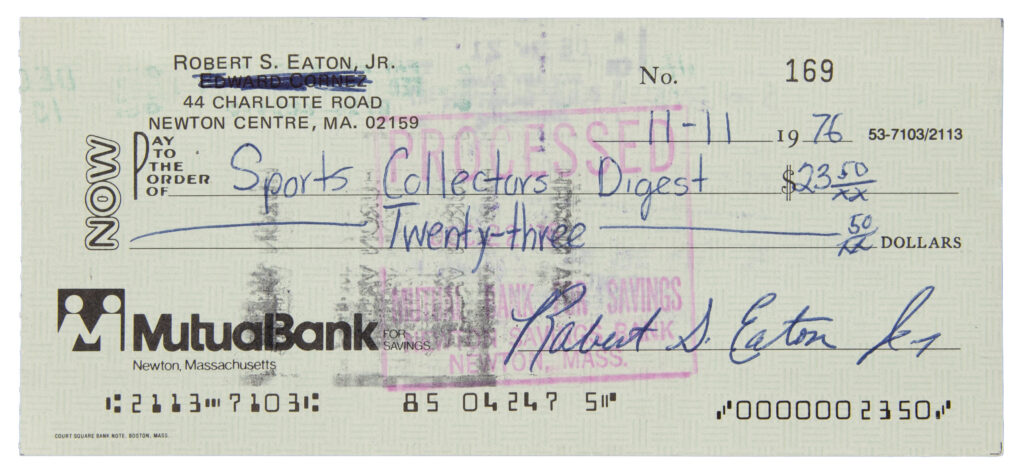
Bob Eaton, who started this whole thing, hand-typed our first catalog in his parents’ basement in 1980. We’ve published one every month since, almost 800 now, and never missed a month. He told me he didn’t save number one. But at the bottom of a bin he’d kept the first Sports Collectors Digest he ever advertised in, along with a packet of old checks from 1976. So I started flipping through it.
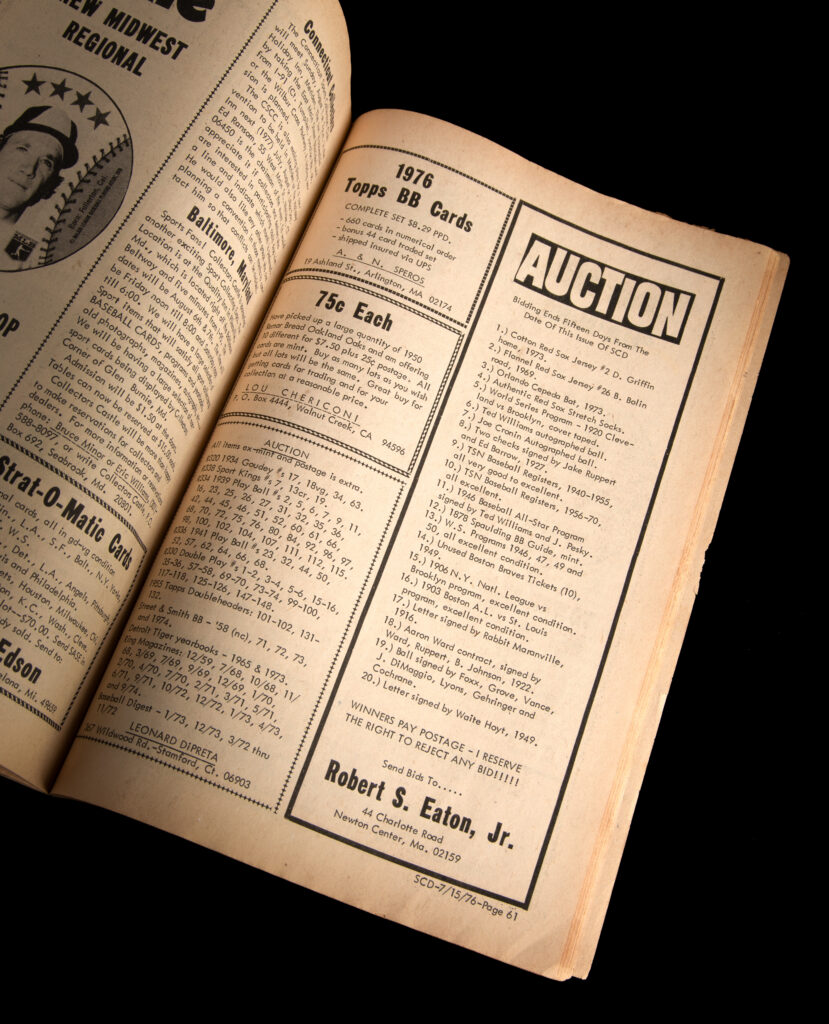
On page 61 of the July 15, 1976 edition, there it was. The very first ad RR Auction ever ran.
It’s headed, in big bold capital letters, AUCTION. Bidding ends fifteen days from the date of the issue, mail bids only, twenty lots. An 1878 Spalding Baseball Guide. Two autographed baseballs, one signed by Ted Williams, the other by Foxx, Grove, DiMaggio, and Gehringer. Two 1927 Yankee checks.
Then, at the bottom: WINNERS PAY POSTAGE. I RESERVE THE RIGHT TO REJECT ANY BID!!!!! Signed, Robert S. Eaton, Jr., 44 Charlotte Road, Newton Center, Mass.
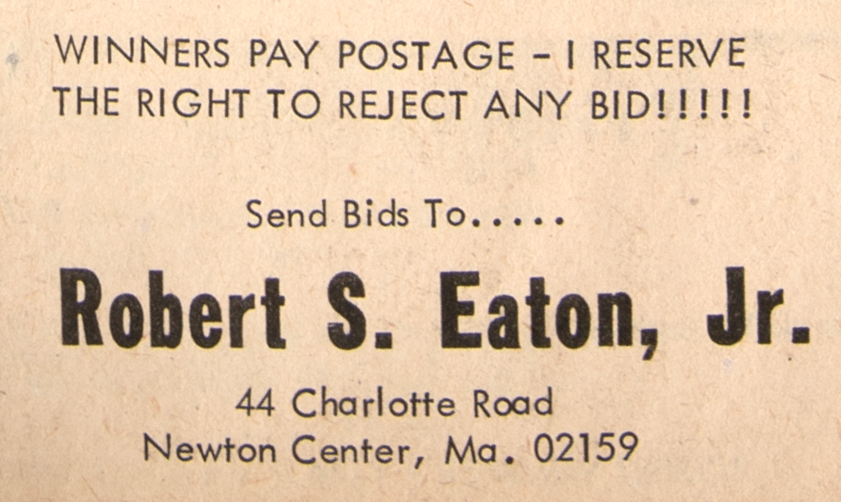
When I see those five exclamation points, that’s my cousin Bob asserting himself. “This is my business, these are my terms, this is how I’m doing it.” He was nineteen, his own money on the line, working out of his parents’ basement. Fifty years later, the exclamation points are gone, but the determination behind them never left.
And I know all about that basement, because fifty years ago, I was there. Not for a lot of it, but I was there when it started. I was just a kid, and I have watched this company grow.
There are two sides to every story. Bob told his earlier this year. This is how I remember it.
Our grandfather, Eddie Cornez, had set aside some money for Bob’s college tuition. The thing was, Bob wasn’t going to college.
There was an ad in a Newton paper for a sports memorabilia collection. Bob and Eddie went to look. Nobody knew what it was worth. Everybody, including his parents, thought Bob was crazy. Everyone except my grandfather. Eddie paid the man $1,800, the college money, and told Bob that was fine. It all ended up in the basement of Bob’s parents’ house on Charlotte Road, and everybody walked away and left Bob standing there with a mountain of stuff and exactly one question.
How do I sell this?
This is the moment Bob becomes an entrepreneur. Nobody gave him a plan. The way he puts it: “Nobody said a word. It was like, here’s the stuff.” How did he figure out how to sell it? “I have no idea,” he says. But he did.
That instinct became the whole company philosophy. Bob calls those early years pure trial and error. What works? Try it. If it doesn’t, try something else, and don’t stop. The sports memorabilia business was just taking off, and Bob wanted to get the word out that he had some good stuff. So he placed the ad in SCD.
My grandfather didn’t really understand this business, but he knew something about staying the course. As Bob struggled through those early years, he gave him one piece of advice. “If you can make it five years in business,” he told him, “you’ll be successful. Just hang on for five years.”
Bob made it fifty.
I was twelve that summer of 1976. Three older sisters, no brother, and Bob, my cousin, was the closest thing I had to one. My mother shipped me to Boston for a couple of weeks every summer, and the bicentennial meant I was up there even more than usual. I shouldn’t have been available at all. I’d failed Latin and gotten sentenced to summer school, and I skipped a good chunk of it to be in Boston for the Red Sox. That was the spirit of ’76 in my family.
Mostly I remember the basement. Musty, no heat, a flood every time it rained, and Bob down there every single day, completely in love with it. He had traded a college education for a long road learning how to pay the bills, start a young family, and keep his head above water, or in this case, above the floods in the basement.
Bob heard about the Norton Flea Market, out in Norton, Massachusetts, which meant getting up at 3:30 in the morning. When I visited in the summers, I got up with him, watching the buying and selling take shape. He’d drag me down to a warehouse near Fenway, Twins Enterprises, the company you’d know today as ’47, where he bought yearbooks, pennants, and bobbleheads by the case for next to nothing and resold them at the flea market.
Every summer there was a new angle. One year he had me writing to movie stars for signed photos. The next, we were working the hotel lobbies where visiting ballplayers stayed. Little by little, Bob was building a reputation as an autograph company, and as far back as I can remember, he guaranteed the authenticity of everything he sold. That was rare back then, and it became the foundation of the whole business. I was just a kid, but I was fascinated, and I got to watch it all happen.
Here’s my place in company history. I was the first person RR ever put on the payroll, and the first one it ever fired. After college I went to California to break into the movie business, and when that stalled and I needed money, I talked Bob into a job and moved to Boston in 1984. I pitched a magazine called Autograph Monthly. He gave me six months and a real shot, and it failed miserably. I didn’t have Bob’s work ethic back then.
I didn’t take it well, but I learned from it. Bob had taken a chance on me, and now I was on my own again. So I went back to Hollywood, started my own business, and worked in advertising, marketing, and filmmaking.

The auction kept growing, and I’d cross paths with them now and then. Bob worked alone for ten years before hiring Bill White in 1986, his first lasting hire, and that was the year they finally got out of the basement. Forty years later, Bill is still here. Between them, Bob and Bill became two of the most trusted authenticators in the business, which is still the basis of everything we do. The little baseball operation had become a world-class house for autographs, documents, and manuscripts. RR ran its first real auction in 1995, by phone, and stayed on the phones until 2001. Those phone years were the hard part. Moving to computer-based bidding revolutionized the company.
Around 1999, I went up to visit, and the company had grown. Real offices now, in Bedford, New Hampshire, with over ten employees. One of the people there wasn’t an employee yet. He was a kid with a vacuum.
That kid was Bob’s son, also named Bobby. It gets confusing with all the Bobs, so we go by number: Bob is B1, I’m B2, the kid is B3. I remember thinking, who is this? He was sixteen. The company had just fired whoever cleaned the offices, and out of that little chaos, Bobby saw an opportunity. He bought his own vacuum, started his own cleaning company, and told his dad to hire him because he’d do it better than the last guys. And he did. The way he tells it, he cleaned the offices “like a peasant,” and buying that vacuum made him “an idiot.” He was not an idiot. Who at sixteen does that? I saw the budding entrepreneur in him, following right in his father’s footsteps. Bobby didn’t ask. Bobby did it.
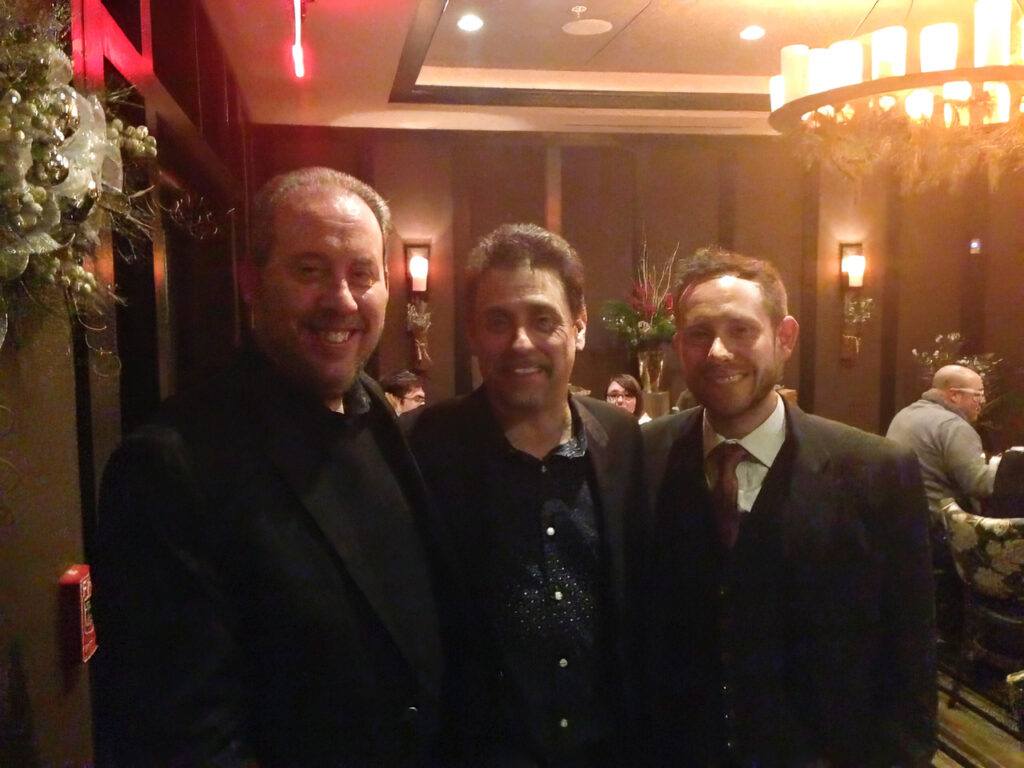
He came on full-time in 2006, the same way, by seeing a chance and taking it. The photographer quit right before a deadline, Bobby stepped in, and he never left. From photography he moved into catalog design, then operations. None of it was luck. It’s the old thing about hard work putting you in the room when opportunity shows up, and being the one who recognizes it. Bobby always did.
That’s the thing about Bobby. Anything that needed doing, he got done. We never asked anyone. We just do it. He kept at it until one day he was running the place. He’s our COO now.
In 2005 I started another company, but the real estate crash took it down. By 2008 I needed money, so I called my cousin Bob, the guy I considered an older brother, and asked him for a loan. He said no.
What he said instead was, come up here and consult. I needed the money. You’re going to pay me to come up there? I’ll come up there. Out of my own chaos, Bob handed me an opportunity. Not a handout, a chance. So in 2009 I came up, and this time I stayed.
He wanted me up there because I’d built a career in PR and marketing, and the branding had gotten stale. Bob and his family had built something great, but they were too close to see the obvious. So all I did was “state the obvious,” and they thought I was a genius. A marketing genius! It wasn’t that at all. A fresh pair of eyes changes everything. And he paid me enough to cover my bills.
“Stating the obvious” turned into something much more. I couldn’t believe the history in the items we were selling, or how much I connected to them. So I convinced Bob Eaton to hire me full time, at peasant wages too, just like Bobby. I came in loaded with ideas for growth. I’d had ideas before, of course. I’m the one who pitched Autograph Monthly! So whenever I came up with something obvious to me, Bob would look at me skeptically and ask, who’s gonna get this done? And from watching him, I knew. The kid with the vacuum.
By then Bobby and I were a good team. When he got offered a space artifact collection, something we’d never touched since we were strictly autographs, I had the idea to run a second auction each month and build a whole specialty category around it. That sounds simple. It wasn’t. RR had run one auction a month for thirty years, and every system was built around that one sale. A second meant rebuilding all of it. I got Bob and Bobby to believe in it, and Bobby said, get out of my way, I’ve got this. He rebuilt the operation, and it worked. Soon we were announcing a live Bonnie and Clyde auction to a company that knew nothing about running one, and he pulled that together too. We’d doubled our sales and added whole new kinds of product. The exponential growth started, because of him.
And it was never just the three of us, the three B’s. We got the whole company and the family to buy in, including Bobby’s two sisters, who worked at RR then. The biggest job was the website, never really a website, just a bidding platform we’d cobbled together ourselves. Bobby rebuilt it from scratch. It took the better part of ten years and produced some spectacular failures, and we stuck with him through every one. We pointed plenty of fingers right at him, but we knew he’d get it done. When one of us was wrong, and we all were plenty, we kept moving and never made the other one pay for it. We let each other fail, and we never let each other fail alone.
And Bob kept bringing us back to the conservative approach he’d run on from the start. As he puts it, “small steps, not huge ones that could jeopardize what’s happening.” He had plenty of ideas of his own, too, and the three of us challenged each other constantly, with no fear of offending anybody. He let us take our swings, but made sure not one of them could ever take down the company.
Since I’ve been here, Bob, his son, me, and the whole staff have accomplished remarkable things. Unbelievable things. The staff embraced every change we threw at them, and most have been with us over a decade. We had our first million-dollar auctions, then our first million-dollar items, and in January of 2026, for our 50th anniversary, an $8 million auction. The centerpiece was Apple Check No. 1, the very first check Apple ever wrote, back in 1976. And we’ve had a lot of fun working with some of the best collectors in the world.
I never did find catalog number one. But promoting that Apple check got me thinking, and as an old marketing guy, the tie-in was obvious. Apple and RR, born the same year, both turning fifty. One of them changed the world. The other is an auction house, and it changed mine. There I was, holding our first ad and our earliest checks, about to sell theirs.
I also got to thinking about my grandfather. Bob always teases me that he was the favorite. He obviously was! Not that it matters. He set up an $1,800 college fund for Bob and nothing for me. But that $1,800 turned out to be the best setup for me too. He might not have meant it that way, but my grandfather sure took care of me.
So let me state the obvious one more time, because that’s what they hired me to do. We’re not perfect, and we’ve taken plenty of chances that didn’t pan out, but when something’s wrong, we make it right. What sets us apart isn’t expertise. Lots of people have that. It’s how hard we work for both sides of every sale, and the trust we’ve earned, on authenticity and on how we treat people. The best collectors in the world keep coming back. And when we lose one, because over fifty years you do, their family brings us a lifetime’s collection, and we do everything we can to honor that person and do right by their estate. We care. It started in a basement at 3:30 in the morning, and we work just as hard today. The numbers are just bigger.
We’ve got a lot to be proud of. Bob was told to make it five years. We made it fifty. And someday, when Bob and I decide to step away, there’s going to be a vacuum. Good thing we’ve got the kid to fill it.