

The Pinnacle of the Special Relationship
The Invasion of Europe
The personal archive of Major-General Sir Miles Graham, MGA, 21st Army Group
In his recent address to the United States Congress, His Majesty King Charles III spoke of values shared between the British and American peoples that reach back two and a half centuries. There is no single moment at which those values were tested more severely, or shared more completely, than the eleven months that begin with the Normandy landings of 6 June 1944. The archive here described is the surviving working record of that partnership at its highest point: a collection of contemporary Top Secret Battle Directives, distributed by hand to fewer than twenty men, that together cover nearly every major Allied offensive from D-Day to the German surrender in May 1945.
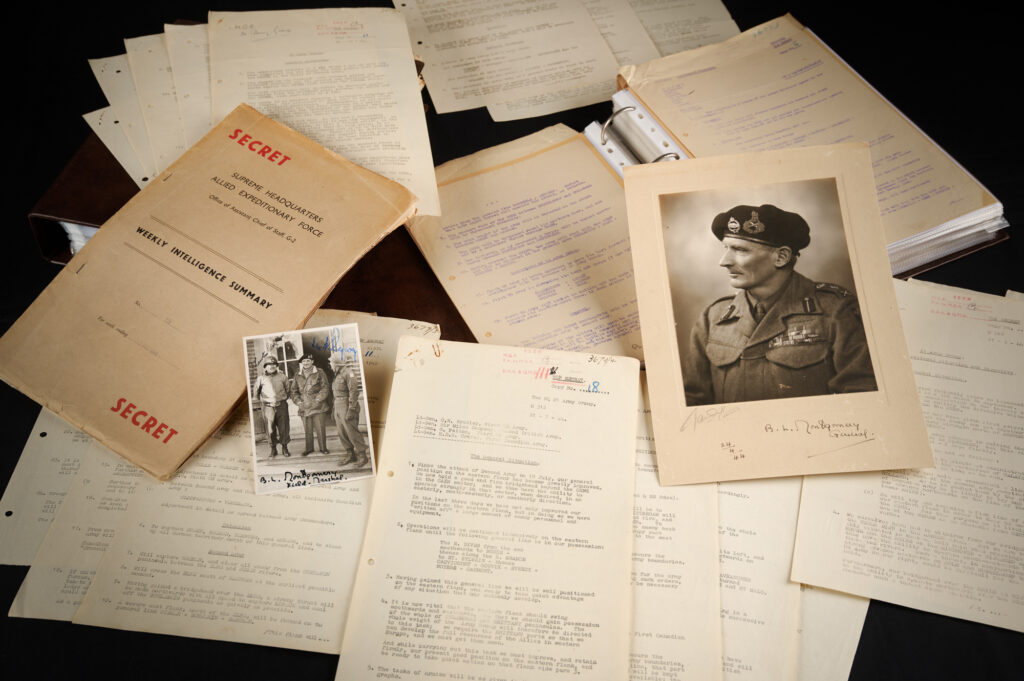
These are not historians’ reconstructions. They are operational documents, issued in their day by Field Marshal Montgomery and his staff, retained as personal copies by Major-General Miles Graham, the Major-General in charge of Administration (MGA) at 21st Army Group, and bearing the initials of the men who read them. The named recipients are a small and immediately recognisable circle: Churchill, Eisenhower, Bradley, Patton, Dempsey, Crerar, Bedell-Smith, Alan Brooke, de Guingand, Leigh-Mallory, Cunningham, Simpson, with the staff officers Graham, Poole and Belchem. They are, between them, the senior Anglo-American leadership of the war in Western Europe.
Eighty-eight days
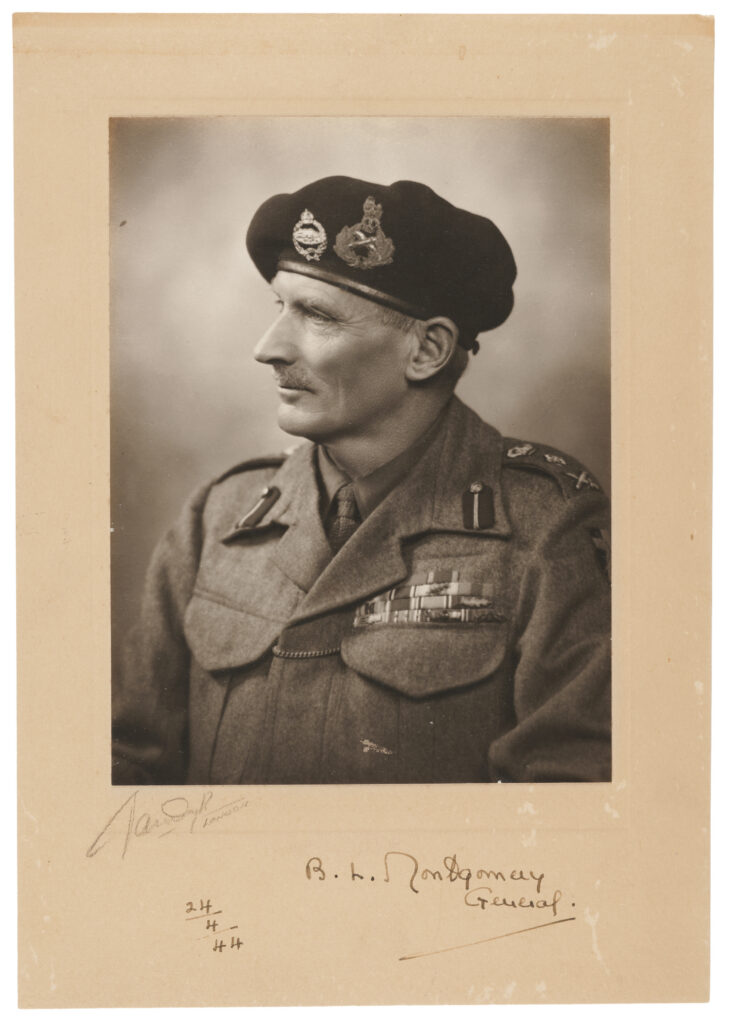
As Supreme Commander of the Allied Expeditionary Force, General Eisenhower delegated to Montgomery the conduct of all Allied ground forces in the field from D-Day until 1 September 1944, the date on which the United States 12th Army Group under Bradley and the 6th Army Group under Devers were fully deployed in France and Eisenhower assumed direct ground command himself. For those eighty-eight days a British general directed American armies in the field — a circumstance which had not occurred since the eighteenth century, and which speaks to the trust that existed between the two commanders. The directives of this period are accordingly of unusual significance, and the archive contains the fullest sequence of them known to remain in private hands. The collection was appraised and inventoried in 2000 by Roy Davids (1943–2017), the internationally renowned manuscript expert who headed Sotheby’s Manuscripts and Books Department for over two decades.
What strikes a viewer on first encountering the directives is the TOP SECRET designation typed across each cover, and the knowledge that this exact paper was placed into the hands of Churchill, Eisenhower, Bradley and Patton. Reading through them, one sees iconic American formations — the 82nd Airborne, the 101st Airborne, even Patton’s Third United States Army — receiving their operational orders from a British commander. It is a remarkable historic record, and one that few American readers today are likely to have encountered: that for a period in 1944, and again during the crisis of the Ardennes, Field Marshal Montgomery led American forces to victory in the field.
And one hears Montgomery in his own voice. The directives are written in the first person and signed in his hand. Personality runs through them — directness, certainty, the occasional flash of impatience, and an unmistakable sense of a single mind in command.
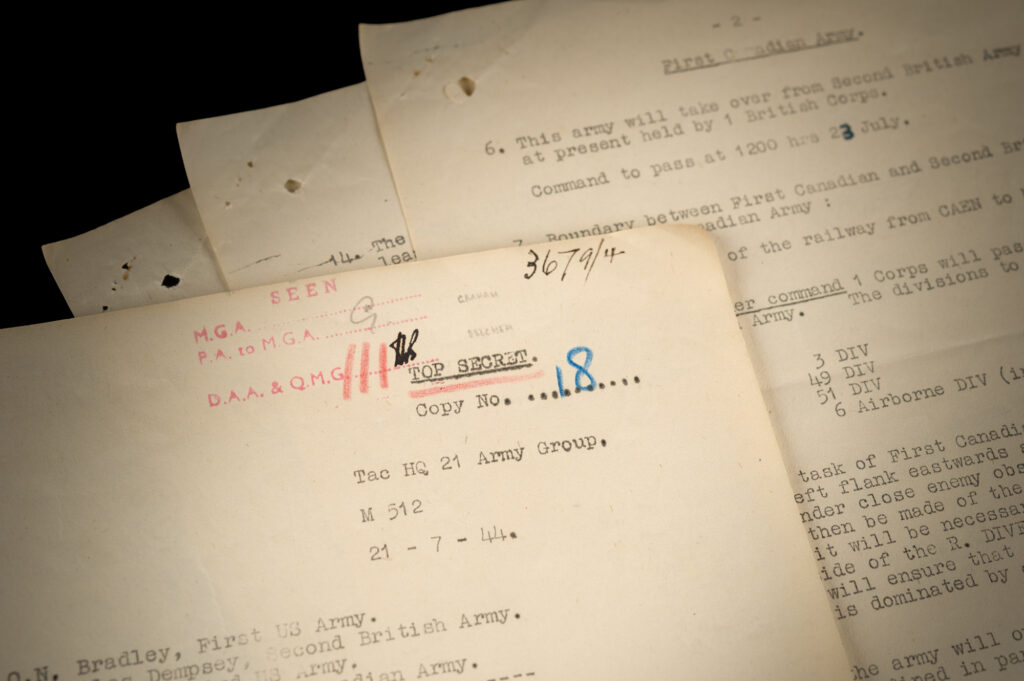
M512, dated 21 July 1944, contains the actual plan for the breakout from the Normandy beachhead — Operation Cobra, which was led with great force and skill by Bradley’s First United States Army and broke the German line in the West. Surveying the position from his Tactical Headquarters, Montgomery wrote:
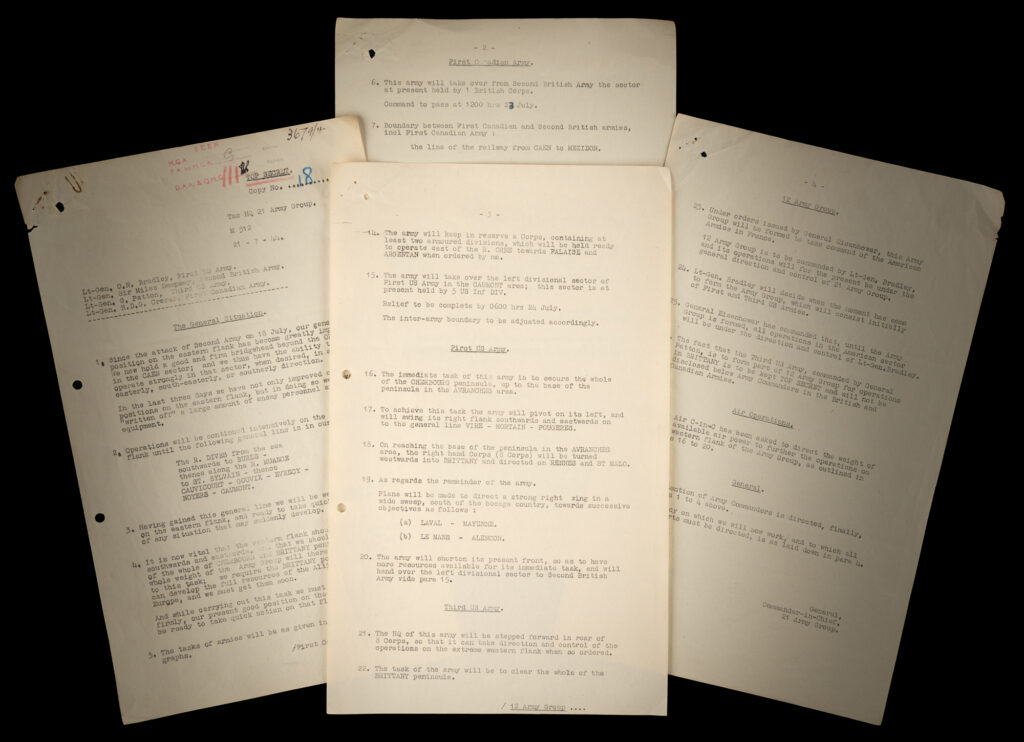
“Since the attack of Second Army on 18 July, our general position on the eastern flank has become greatly improved … In the last three days we have not only improved our positions on the eastern flank, but in doing so we have ‘written off’ a large amount of enemy personnel and equipment. … It is now vital that the western flank should swing southwards and eastwards, and that we should gain possession of the whole of CHERBOURG and BRITTANY peninsulas. The whole weight of the Army Group will therefore be directed to this task; we require the Brittany ports so that we can develop the full resources of the Allies in western Europe, and we must get them soon.”
M515 develops the exploitation. M516 (4 August) opens the Battle of the Falaise Gap, in which the German Seventh Army was largely encircled and destroyed by converging Allied forces — Patton’s Third Army driving north, the First Canadian Army driving south, the British Second Army from the east. M517 sets out the design of the encirclement plainly:
“To pivot on our left, or northern flank. To swing hard with our right along the southern flank and in towards PARIS, the gap between PARIS and ORLEANS being closed ahead of our advance. To drive the enemy up against the R. SEINE, all bridges over which between PARIS and the sea will be kept out of action.”
M518 closes the Falaise Pocket; M519 drives to the Seine; M520 carries the line forward to the Somme. M522, dated 29 August and described in the archive’s contemporary inventory as Montgomery’s last directive as C-in-C Allied Ground Forces, instructs 21st Army Group to assist Bradley’s American forces in their advance towards Aachen. The sequence is the operational paper trail of the liberation of Northern France, written jointly into history by armies of two nations.
Market Garden
Three days later, on 2 September, Montgomery issued his first directive as Field Marshal — M523, the first paper to mention Arnhem. M525, of 14 September 1944, is the operational order for Operation Market Garden, the airborne and ground offensive intended to seize a Rhine bridgehead and turn the war’s northern flank. Its strategic logic is laid down in Montgomery’s own words on the cover sheet:
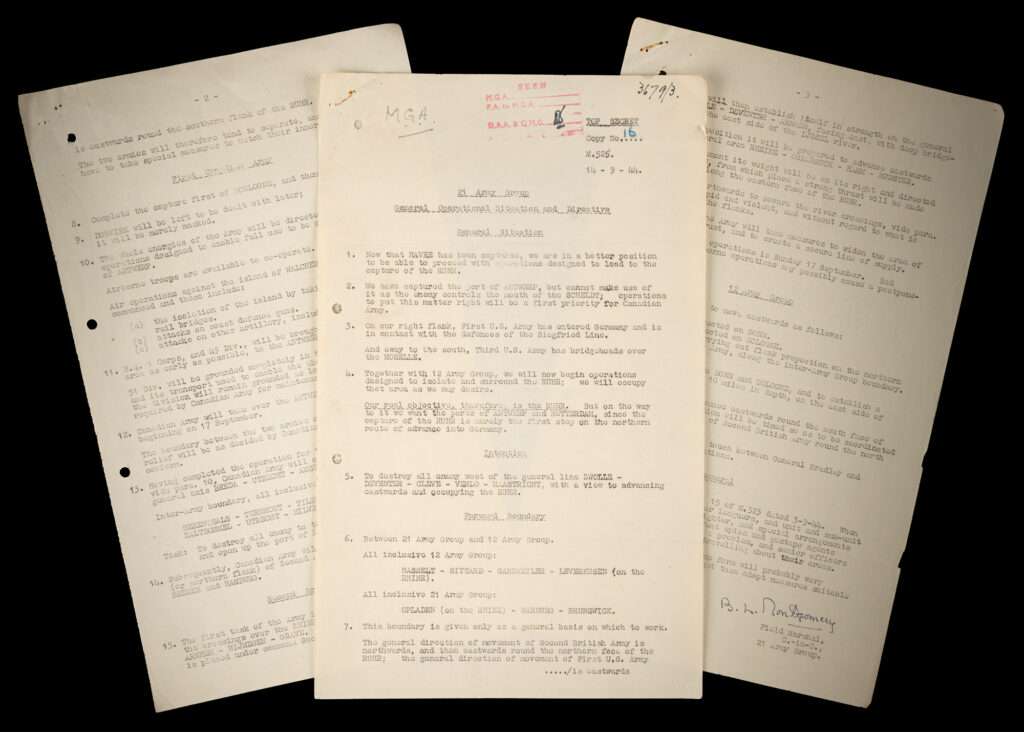
“Now that HAVRE has been captured, we are in a better position to be able to proceed with operations designed to lead to the capture of the RUHR. … Together with 12 Army Group, we will now begin operations designed to isolate and surround the RUHR; we will occupy that area as we may desire. Our real objective, therefore, is the RUHR. But on the way to it we want the ports of ANTWERP and ROTTERDAM, since the capture of the RUHR is merely the first step on the northern route of advance into Germany.”
Market Garden did not achieve its furthest objective. The bridge at Arnhem was held by the British 1st Airborne Division and the Polish 1st Independent Parachute Brigade for nine days against overwhelming German armour, but the ground advance — led by the American 82nd and 101st Airborne Divisions and XXX Corps — could not reach them in time. Montgomery’s next directive, M527 of 27 September, written as the bridgehead was being given up, contains a single line of unmistakable understatement:
“We ourselves have had to withdraw from our bridgehead over the NEDER RIJN in the ARNHEM area. … The enemy has achieved some success in cutting the Second Army corridor northwards to NIJMEGEN; but this situation has now been got in hand — I hope finally.”
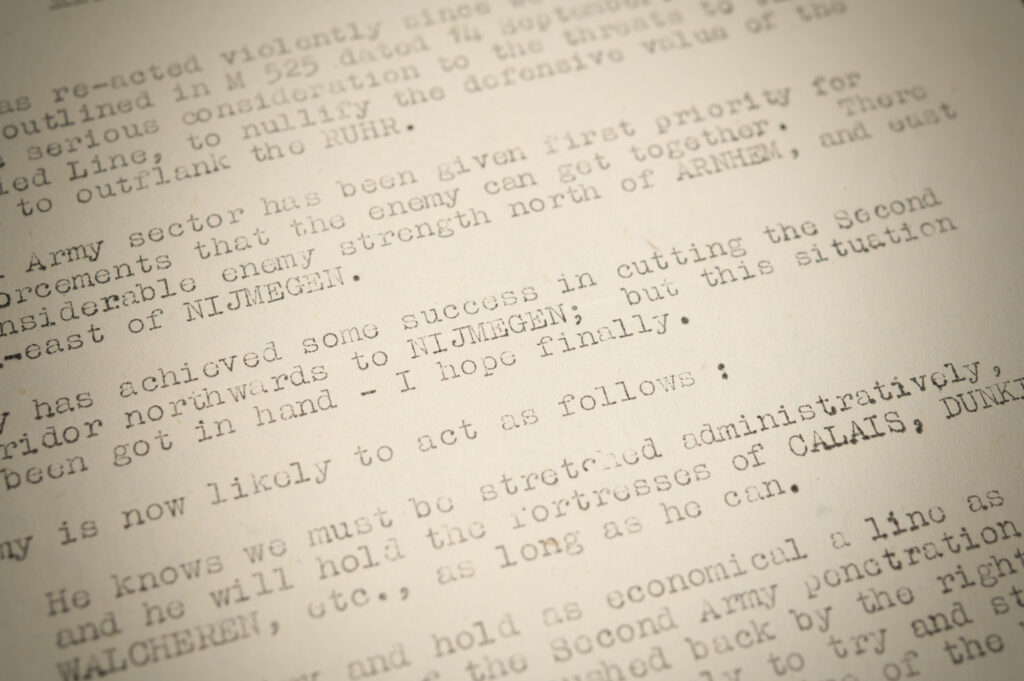
Three words — “I hope finally” — carry the weight of the operation. The directives that follow (M529, M530, M532, M534) record the autumn fighting that secured the Nijmegen bridgehead, captured Antwerp, and prepared for the Battle of the Rhineland.
The Ardennes
The second occasion on which Eisenhower placed American forces under Montgomery’s command came under conditions of crisis. On 16 December 1944, the day on which the German Ardennes offensive opened, Montgomery issued Battle Directive M538 — a directive prepared in ignorance of the attack about to fall on Bradley’s front. Its closing paragraphs concerned secrecy:
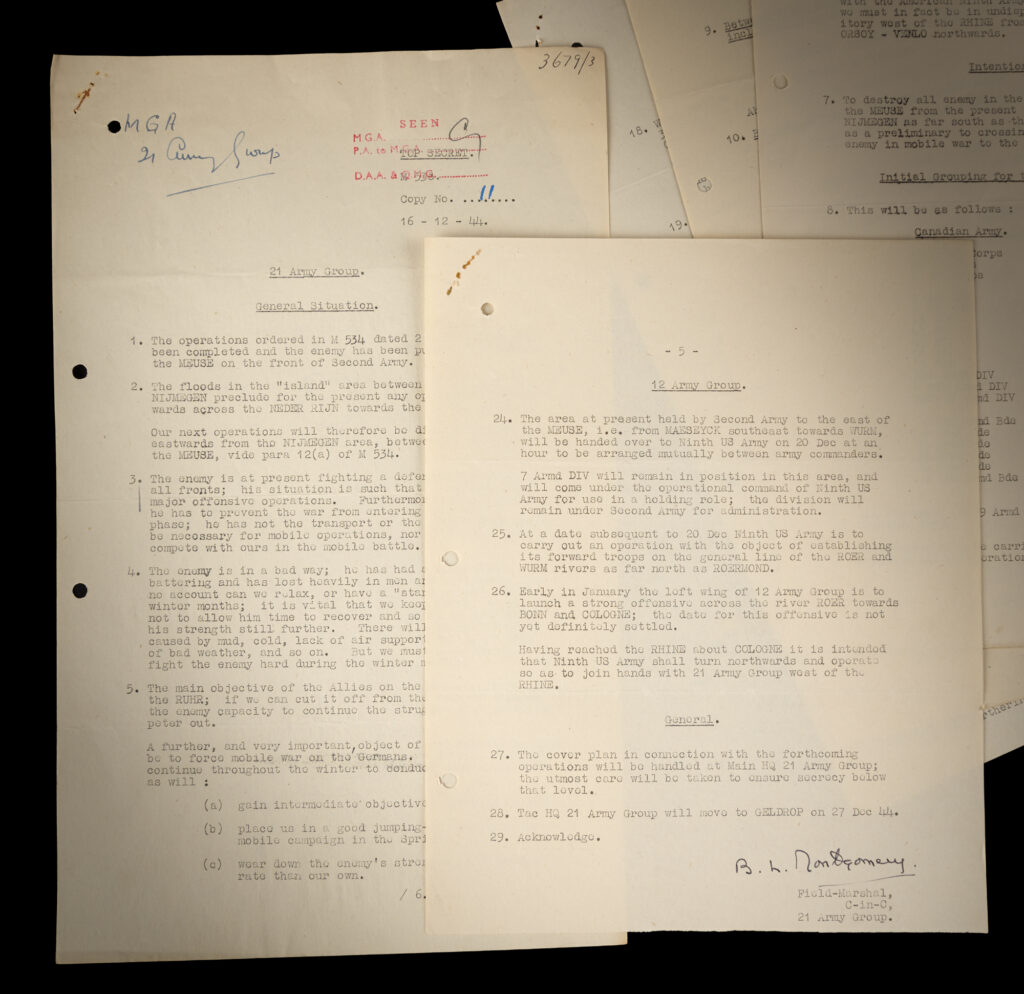
“The cover plan in connection with the forthcoming operations will be handled at Main HQ 21 Army Group; the utmost care will be taken to ensure secrecy below that level.”
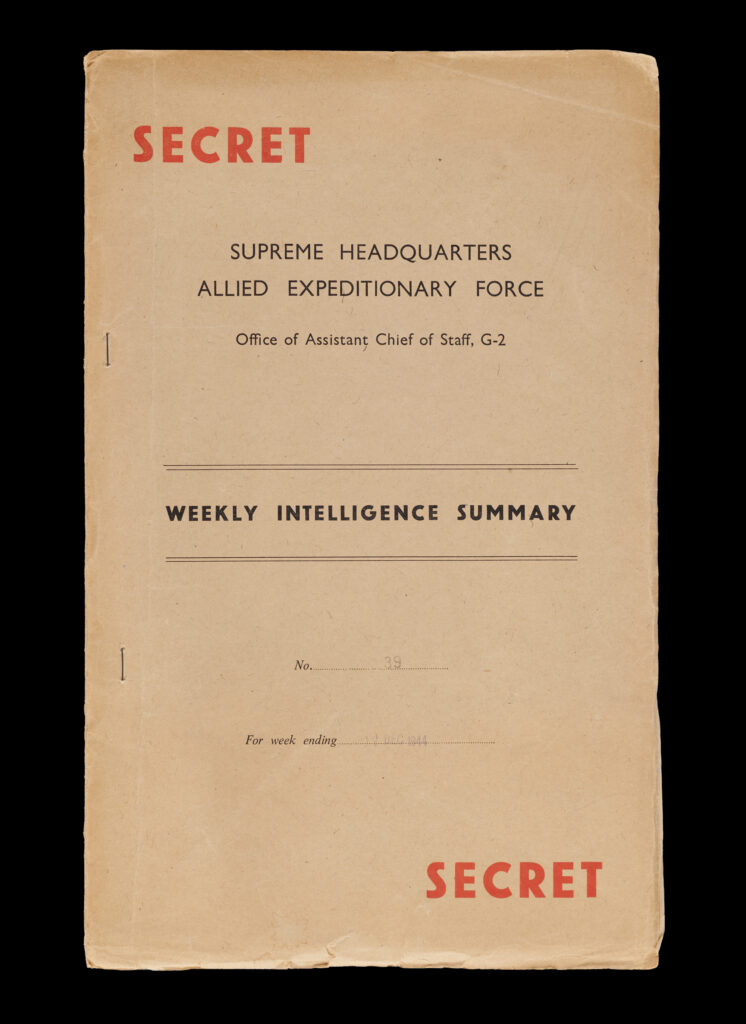
It is preserved here, the archive’s contemporary inventory describing it bluntly as a record of “one of the most incredible intelligence blunders of the Second World War.” Accompanying it is the personal copy of SHAEF Weekly Intelligence Summary No. 39, prepared by Eisenhower’s chief of intelligence, Major-General Sir Kenneth Strong, and submitted the day after the attack began. The intelligence failure was an Allied one, shared at the highest levels of the combined command, and the document at the centre of it is present here in Strong’s own copy.
Within days, Eisenhower made the decision — controversial at the time and much discussed since — to place the United States First and Ninth Armies temporarily under Montgomery’s command in order to stabilise the northern shoulder of the Bulge while Patton’s Third Army drove north from the south. The arrangement was operational and pragmatic, and it worked. By 21 January 1945, with M548, Montgomery was looking past the Ardennes to the Rhineland:
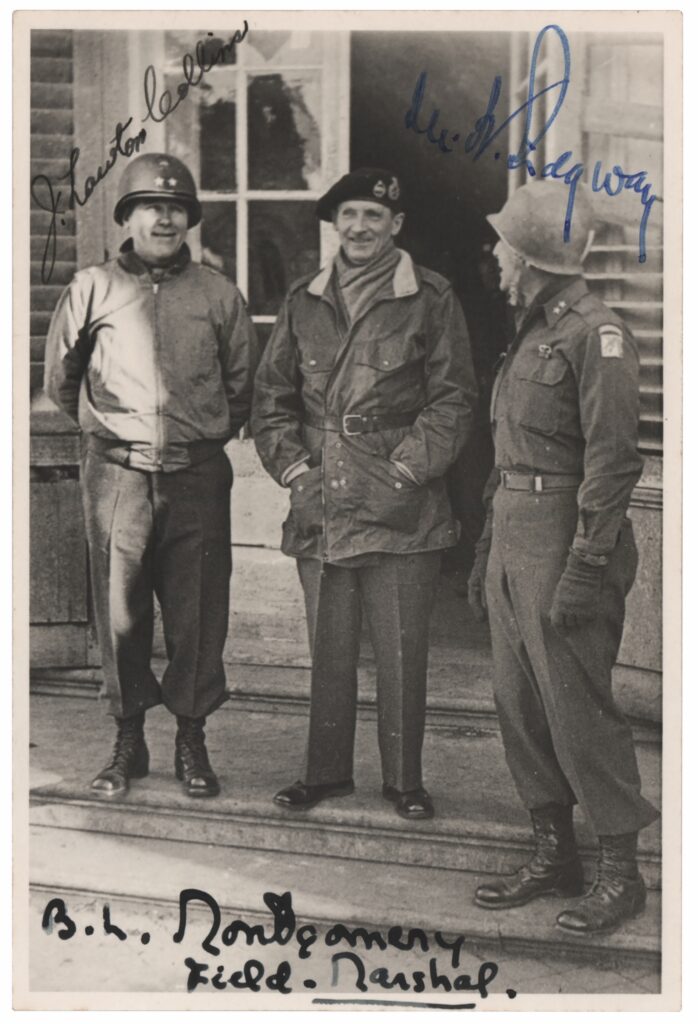
“The enemy has suffered a tactical defeat in the ARDENNES, with severe losses in men and material. … The enemy is in a bad way; he has had a tremendous battering and has lost heavily in men and equipment. On no account can we relax, or have a ‘stand still,’ in the winter months; it is vital that we keep going, so as not to allow him time to recover and so as to wear down his strength still further.”
M548 set out Operations Veritable and Grenade, the converging British-Canadian and American attacks that would clear the west bank of the Rhine. The Ninth United States Army, under General Simpson, would remain attached to 21st Army Group through the crossing of the Rhine itself in March 1945; Simpson and his men earned the lasting respect of their British and Canadian counterparts, and that respect was returned. Montgomery’s directives M559, M563 and M567 record the operational detail of the Rhine crossing, the advance to the Elbe, and the capture of Bremen.
The Drive to the Batlic
The archive closes with M574, dated 22 April 1945 — the last battle order of the war in Europe. It opens with a single sentence that carries the war’s end within it:

“We have now reached the ELBE astride HAMBURG, are closing in on BREMEN, have liberated northeast HOLLAND, and have isolated western HOLLAND.”
Its operational intention is set out in eleven plain words — “to capture EMDEN, BREMEN, HAMBURG, and LUBECK, and to clean up all German territory north of this general line” — and the drive to the Baltic that followed sealed off the German forces in Denmark and brought Anglo-Canadian forces to the western Schleswig-Holstein coast in time to forestall a Soviet arrival there. A separate item records Montgomery’s conference with General Crerar of the First Canadian Army at Grave on 12 April. A still later item, of 12 June 1945, contains Montgomery’s conference for Corps District Commanders in the British occupied zone of Germany, marked Top Secret and Personal.
The Proportions of the Partnership
The directives describe operations conducted by armies; they do not describe the demographic facts that lie behind those armies. Those facts are worth recalling alongside the operational record, because they are increasingly little known.
Across the Normandy campaign of June–August 1944, British, Canadian and Polish forces under Montgomery’s 21st Army Group sustained approximately 83,000 casualties; American forces approximately 126,000. The losses were proportionate to the forces engaged. From the breakout onwards the American share of the burden grew steadily, and by the closing campaigns of the war American forces in the European Theater outnumbered British and Commonwealth forces by a margin of roughly three to one — the consequence both of the United States’ far greater population (some 132 million in 1944, against the United Kingdom’s 47 million) and of the immense scale on which America had mobilised by the war’s final year. American industry, by 1945, had produced more military equipment than all the other belligerents on either side combined; without it, the war could not have been won.
By May 1945 the United States had mobilised some twelve million men and women under arms; the United Kingdom approximately five million, from a population less than a third the size. Each figure, in its own way, is a measure of total commitment. Together they describe the largest combined undertaking of arms in modern history, and one that no nation could have completed alone.
Living History
Such figures are not made to be deployed competitively. They are made to be remembered. The directives themselves do not argue for one nation or another; they record what was done jointly, in trust, by men whose names appear on each cover sheet and whose initials appear on the pages within. They are the working papers of an alliance that, at its hour of greatest test, functioned as a single instrument under a single American supreme commander, with British, Canadian, American, Polish and French formations operating to a common plan.
A British field marshal directed American armies in the field during the breakout from Normandy. He directed them again in the Ardennes. The American Ninth Army crossed the Rhine under his army group in the spring of 1945. The American First, Third and Ninth Armies fought, in different formations and at different moments, alongside or under British and Canadian command at points which decided the war — as British and Canadian formations in turn fought alongside American command throughout the long advance into Germany. None of this was diminution of either side. It was the partnership at work, in the form for which it had been designed by Eisenhower, Marshall, Brooke, Churchill and Roosevelt.
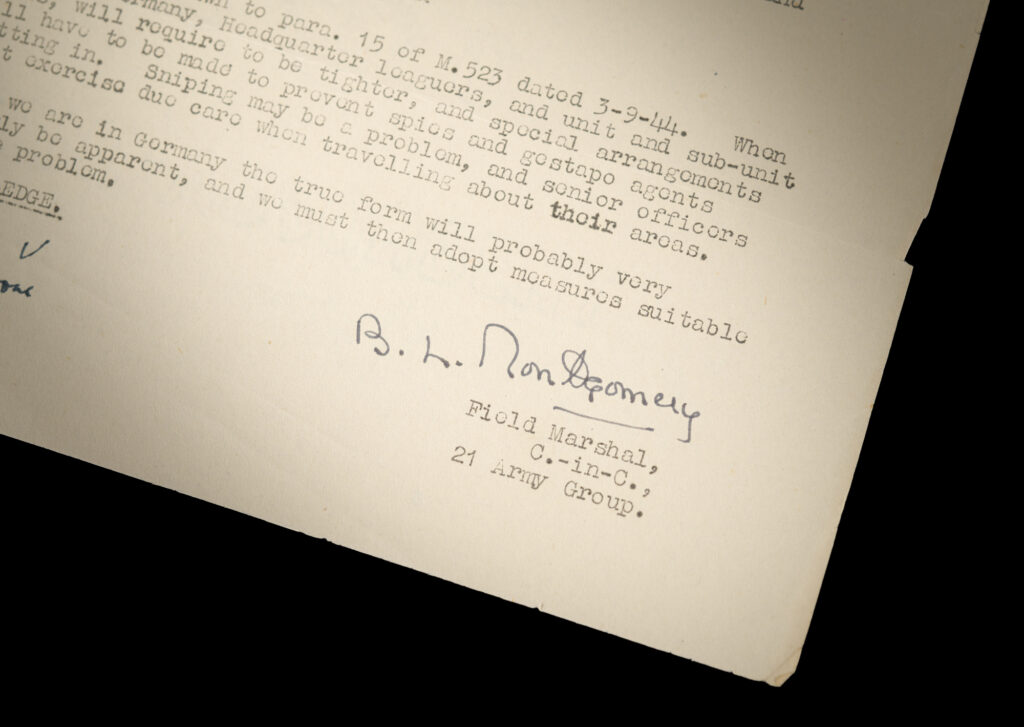
The Battle Directives in this archive are the surviving record of that partnership at the moment of its highest function. They are, in the most exact sense, living history. They were read by Churchill, by Eisenhower, by Bradley, by Patton — and they are presented now in the same condition in which those men received them. They constitute a primary witness to the relationship between the United States and the United Kingdom at the pinnacle of its two-hundred-and-fifty-year history, and to a common sacrifice that does not require ceremony to be acknowledged, only that the record be kept.
