

By Mike Graff
Before it was revealed to the world, before the headlines and speculation, it existed only as a rumor—whispered about in Silicon Valley and guarded behind closed doors. Engineers referred to it by a single name: “Ginger.”
In the late 1990s, inventor Dean Kamen was quietly developing what many believed could redefine personal transportation. According to contemporary accounts, the project drew extraordinary attention even before its public debut, backed by prominent investors including Steve Jobs and John Doerr, with early support from Jeff Bezos. More than $100 million was committed to its development, and anticipation surrounding its unveiling was, at the time, compared to that of the original Macintosh.
What emerged in December 2001 was the Segway—a self-balancing, two-wheeled electric vehicle built on principles that felt, to many observers, almost improbable. But the story of that moment begins earlier, in prototypes like the example now offered by Boston-based RR Auction.
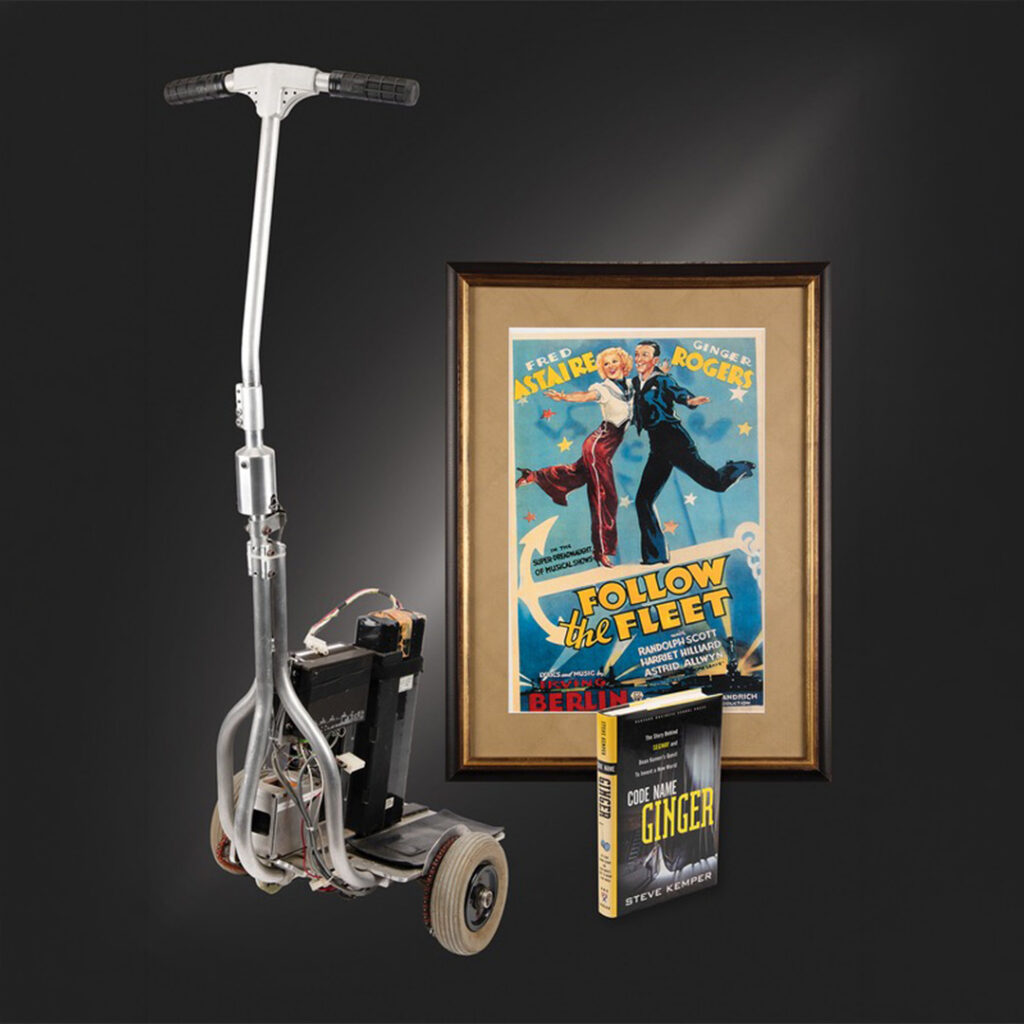
This early “Ginger” prototype reflects the formative stage of the Segway’s design, when its defining technologies were still being refined. Compact and utilitarian in appearance, it lacks the polish of later production models. Yet within its structure are the essential elements that would define the machine: independently driven wheels, gyroscopic stabilization, and a control system that responds not to levers or pedals, but to the rider’s shifting weight.
The underlying concept—dynamic stabilization—allowed the device to maintain balance through continuous micro-adjustments, guided by sensors and onboard computing. As described in period accounts, early demonstrations revealed a machine capable of near-silent movement and precise maneuverability, turning in place with a fluidity that seemed, at first encounter, almost counterintuitive.
The origins of “Ginger” trace back to Kamen’s earlier work on a stair-climbing wheelchair, developed under the codename “Fred.” That project, later commercialized as the iBOT, provided the technological foundation for what would become the Segway. In adapting those systems for broader use, Kamen and his team pursued a more ambitious vision—one that sought to extend beyond medical applications into the everyday movement of people through cities.
The prototype itself retains the physical language of experimentation. A T-handle grip rises from a narrow platform, connected to an early version of the “LeanSteer” mechanism that governs directional control. Beneath the rider’s feet, momentary switches are embedded in rubberized pads, while within the chassis, a nickel-cadmium battery and control unit sit alongside a Watson Industries gyro system. The wheels, modest in size, are driven by a belt-and-gear assembly powered by servo motors mounted beneath the platform.
Even its name carries a sense of continuity and playfulness. “Ginger,” inspired by Ginger Rogers, followed the earlier codename “Fred”—a nod to Fred Astaire. Together, the names reflect the balance and motion at the heart of the invention, a kind of mechanical choreography translated into engineering.
Writer Steve Kemper, who documented the project, recalled his first encounter with the machine in terms that captured both its simplicity and its surprise. At rest, it appeared almost unremarkable. But once activated, it moved with a speed and responsiveness that transformed perception. What seemed plain became, in motion, something entirely different—an object defined not by its appearance, but by what it could do.
In retrospect, the Segway occupies a distinct place in the history of technology. While it did not ultimately reshape cities in the way some early forecasts suggested, it became emblematic of a particular moment—when ambition, capital, and engineering converged around the idea that a single device might change how people move through the world.
This prototype, originating from the collection of former Segway Inc. President and CEO James Norrod and accompanied by a signed letter of provenance, offers a direct link to that moment of expectation. It stands not simply as an early model, but as evidence of a period when the future felt both imminent and uncertain.
The early “Ginger” prototype is being offered as part of RR Auction’s Remarkable Rarities sale, which opened February 20 and concludes March 26. Additional images and catalog details are available at rrauction.com
