

A Complete Flown Apollo Run: What Bill Thornton’s Robbins Medallions Teach Us
Auction note: Astronaut William E. Thornton’s personal collection, 60 lots including a complete run of flown Apollo Robbins medallions, is offered in RR Auction’s Space Exploration and Aviation auction, closing October 22, 2026. Browse the lots.
Ask ten space collectors where to start and most will say the same thing: Robbins medallions. They’re small, they’re silver, and the best of them went to the moon. They’re also confusing if you’re new. Flown or unflown? What do the serial numbers mean? Why is one worth a few hundred dollars and another worth tens of thousands?
This guide answers those questions using one remarkable collection as the example. Dr. William E. Thornton, the NASA physician-astronaut Skylab crews nicknamed “the Isaac Newton of Zero Gravity,” owned a flown Robbins medallion from every crewed Apollo mission, plus flown Skylab, Apollo-Soyuz, and Space Shuttle pieces. Along the way we’ll also cover flown documents, “attested flown” artifacts, and what to look for before you buy.
What Is a Robbins Medallion?
Robbins medallions are small sterling silver (and occasionally gold) medals made by the Robbins Company of Attleboro, Massachusetts, for NASA’s crewed missions, starting with Apollo 7 in 1968 and continuing through Skylab, the Apollo-Soyuz Test Project, and the Space Shuttle program. Each carries the mission insignia on the front and, usually, the crew names and mission dates on the back, plus a serial number stamped on the edge or reverse.
NASA didn’t hand these out. They were ordered and paid for through the astronaut corps. A batch was carried aboard the spacecraft, and afterward they became personal mementos, given to family, friends, and the people who helped make the mission happen.
For the mission-by-mission numbers, the go-to reference is Space Flown Artifacts’ guide to Apollo-era Robbins medallions, which tracks how many were minted and how many actually flew on each mission. The figures below come from their research.
Flown vs. unflown
This is the single biggest factor in value. A flown medallion actually went to space on the mission it commemorates. An unflown medallion was struck from the same dies but stayed on the ground. They can look nearly identical, which is why serial numbers and provenance matter so much.
How to read the serial number
On missions where only part of the run flew, the flown medallions are the low serial numbers. If 80 flew, serials 1 through 80 are the flown ones. According to Space Flown Artifacts, from Apollo 17 onward Robbins also added an “F” next to the serial number on flown examples. That’s why Thornton’s Apollo 17 medallion reads “F36” and his Skylab 2 medallion reads “F47.” Apollo 16 has its own quirk: only the 98 flown medallions were serial numbered on the rim.
How many flew on each mission
The fewer that flew, the harder they are to find. Apollo 11 flew 440 of 450. By Apollo 17, only 80 of 300 made the trip. Here’s the full picture, with the serial of Thornton’s example where he had one:
| Mission | Minted | Flown | Thornton’s flown example |
|---|---|---|---|
| Apollo 7 | 255 to 300 | 255 | No. 156 |
| Apollo 8 | 300 | 300 | No. 243 |
| Apollo 9 | 350 | 350 | No. 297 |
| Apollo 10 | 300 | 300 | No. 15 |
| Apollo 11 | 450 | 440 | No. 282 |
| Apollo 12 | 262 | 262 | No. 213 |
| Apollo 13 | 404 | 400 | No. 300 |
| Apollo 14 | 303 | 303 | No. 194 |
| Apollo 15 | 304 | 127 | No. 088 |
| Apollo 16 | 300 | 98 | No. 79 |
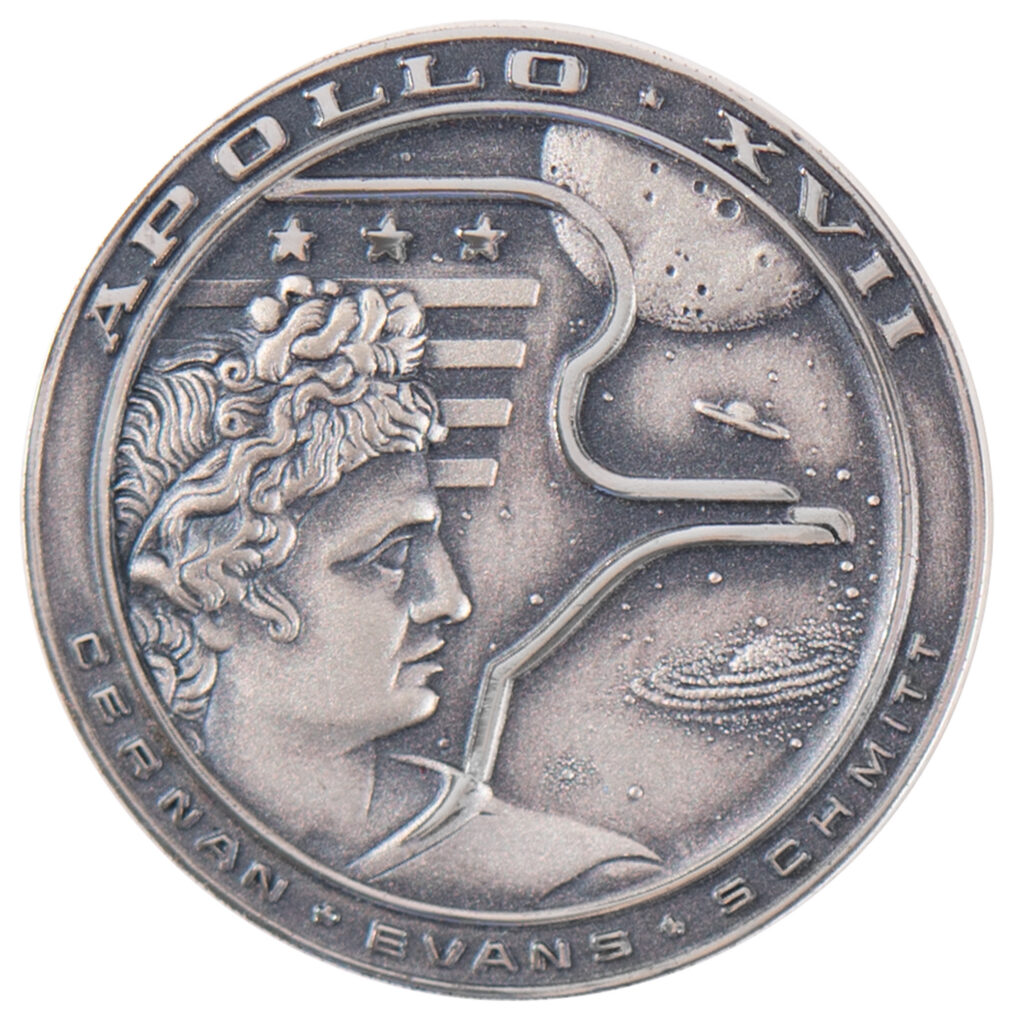
| Apollo 17 | 300 | 80 | No. F36 |
| Skylab 2 (first crew) | 300 | 50 | No. F47 |
| Skylab 3 (second crew) | 159 | 55 | Unflown example only |
| Skylab 4 (third crew) | 190 | 70 | Unflown example only |
| Apollo-Soyuz | 283 | 93 | No. 74F |
Mintage and flown figures: Space Flown Artifacts. Thornton serials: RR Auction catalog.
Gold medallions were made in far smaller numbers. Thornton’s collection includes a flown 10K gold STS-1 medallion, one of 24 flown on the first Space Shuttle mission out of 34 made, and a flown gold STS-51-B medallion, one of 19 carried on his own mission. It also includes unflown gold examples for STS-2, STS-3, and STS-4 (19, 13, and 13 made in gold) and the memorial STS-51-L Challenger medallion, one of only 28 gold out of 370 struck, per RR’s catalog.
What to look for
- The serial number. Check it against the flown count for that mission, and look for the “F” on later missions.
- The hallmark. Robbins stamped its medallions “Sterling,” “Ster.,” or “10K” for gold.
- The original case. Most came in a small plastic case. Having it helps, even when the foam inside has crumbled, which is normal.
- Provenance. Who owned it, and how do we know? A medallion straight from an astronaut’s own collection is about as good as it gets.
- Tarnish is fine. Sterling silver tones with age. Collectors generally prefer honest toning to aggressive polishing.
A Complete Run of Flown Apollo Robbins Medallions
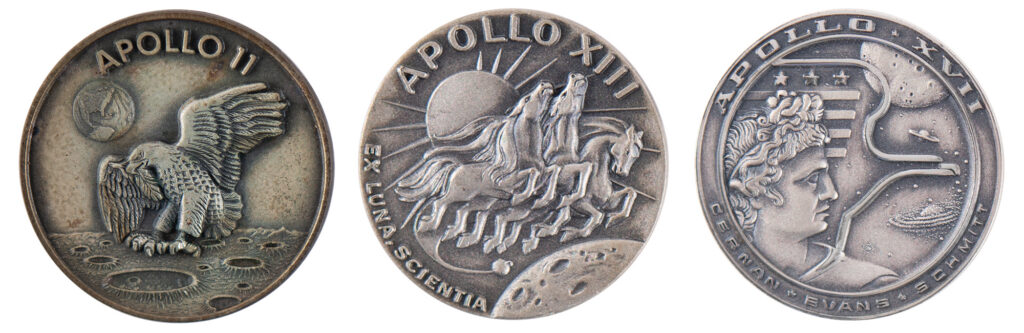
Collectors can spend years assembling a full flown Apollo run, 7 through 17, one medallion at a time. Thornton built his the easy way: he was in the astronaut corps from 1967 on and collected them himself, mission by mission, straight through the corps. All eleven are in his collection, each sterling silver and each in its original case.
A few stand out. The Apollo 11 medallion (serial 282) went to the moon on the first landing. The Apollo 13 medallion has the strangest backstory in the series. The medals were struck with the names of the original crew, Jim Lovell, Ken Mattingly, and Fred Haise. Days before launch, Mattingly was exposed to German measles and Jack Swigert took his seat. After the mission, the flown silver was sent back to Robbins, melted down, and re-struck with the correct names. And because the moon landing was aborted, the back has blanks for only two dates, launch and return, instead of three.
Apollo 17, the last time humans walked on the moon, is the rarest flown Apollo medallion. Thornton’s is serial F36, in mint state.
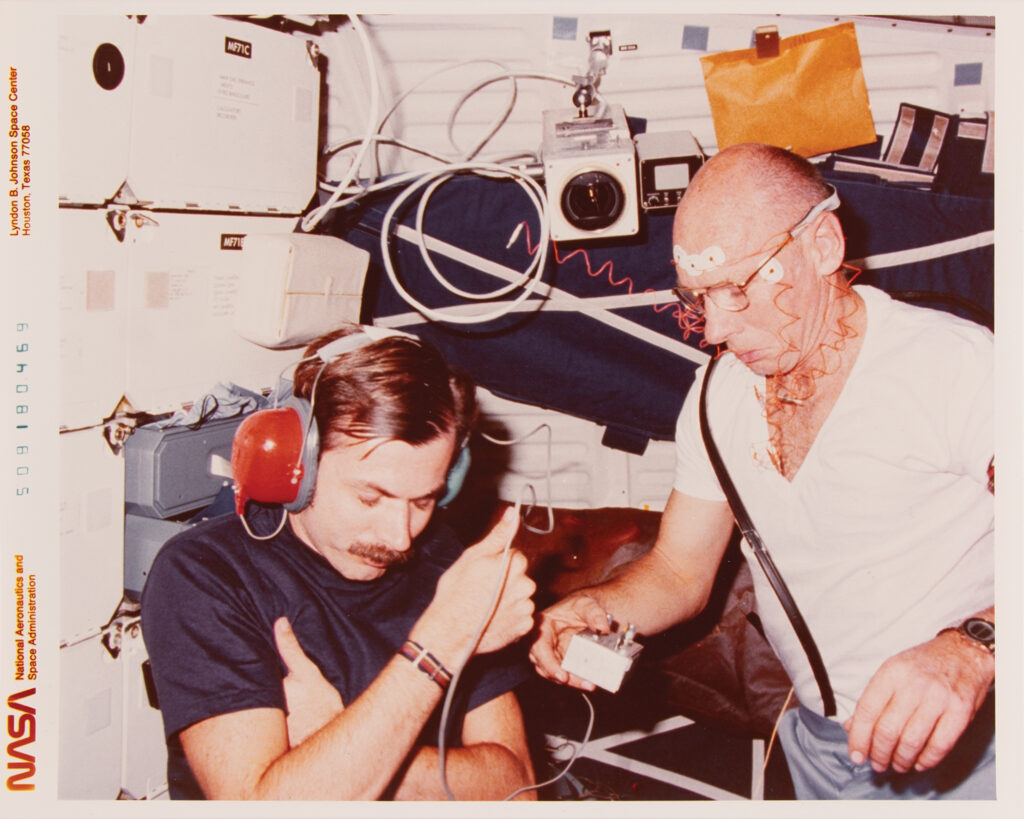
Who Was Astronaut Bill Thornton?
William Edgar Thornton was born April 14, 1929, in Faison, North Carolina. As a high schooler he ran a radio repair shop and used the profits to pay for college, earning a physics degree from the University of North Carolina in 1952. In the Air Force he invented the Radar Optic Firing Error Indicator, better known as the “Thornton Scorer,” the first practical way to measure how accurately interceptor aircraft were hitting their targets. It earned him the Legion of Merit in 1956, as a second lieutenant.
He went on to medical school at UNC, graduating in 1963, then joined the Air Force’s Aerospace Medical Division at Brooks Air Force Base in San Antonio. In 1967 NASA selected him as a scientist-astronaut, one of a small group chosen for their scientific expertise rather than their test-pilot records. He served on the support crews for all three Skylab missions and led Skylab experiments on body mass, body measurements, blood flow, fluid shifts, and exercise.
He finally flew twice, both times aboard the Space Shuttle Challenger: STS-8 in 1983, the first night launch and landing of the Shuttle program, and STS-51-B, also called Spacelab 3, in 1985, where he managed the mission’s animal payload, two squirrel monkeys and a colony of rats. Together those missions logged more than 313 hours in space. Along the way he racked up more than 60 patents, 2,500 hours in NASA T-38 jets, and one of the great astronaut quotes: “I am still the only person that has run around the world on a treadmill that I designed.” After retiring from NASA in 1994, he taught cardiovascular physical diagnosis at the University of Texas Medical Branch and, in his 80s, wrote a textbook on the human body and weightlessness. Dr. Thornton died in January 2021 at 91.
Skylab Artifacts: The Mass Chair and “Thornton’s Revenge”
Skylab was America’s first space station, launched in 1973 and visited by three crews who stayed up for 28, 59, and 84 days. Nobody had lived in orbit that long, and Thornton’s job was figuring out what it did to the human body.
Before any crew flew, NASA ran SMEAT, the Skylab Medical Experiment Altitude Test. Thornton, Bob Crippen, and Karol Bobko spent 56 days in 1972 living in a sealed low-pressure chamber in Houston, running the same experiments, eating the same food, and following the same schedule a real Skylab crew would. Thornton’s SMEAT jacket and trousers are tagged “Crewman: Thornton,” and the SMEAT crew patches feature Snoopy with a rope around his neck, Charles Schulz’s joke about a “grounded” mission.
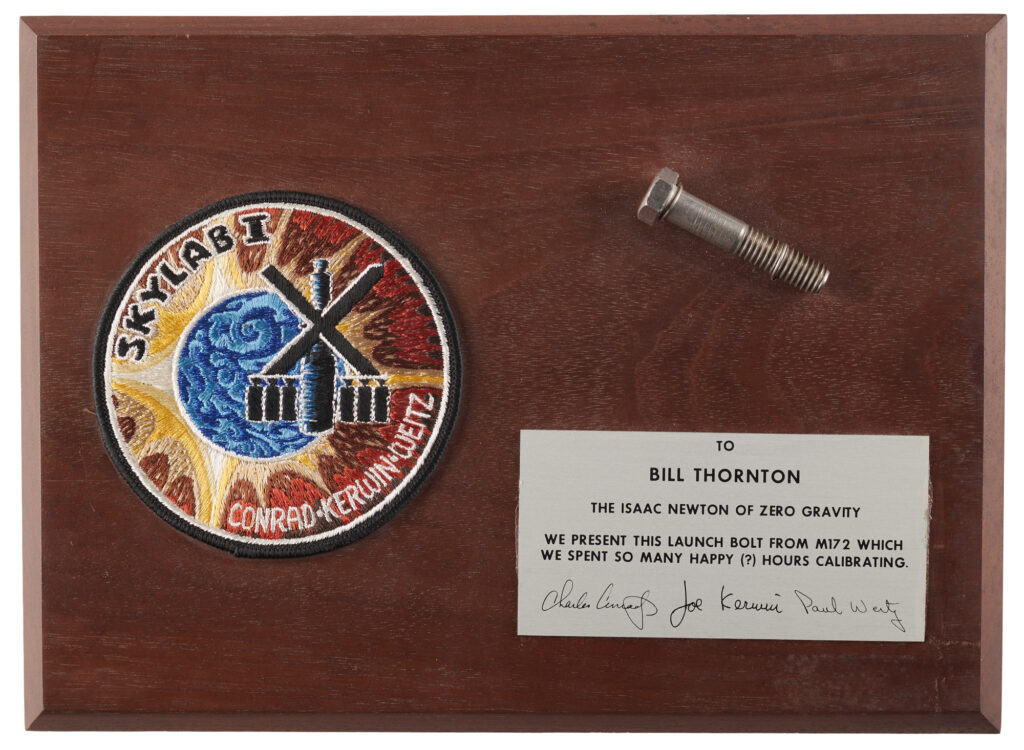
Then came the scale problem. You can’t step on a bathroom scale in orbit, because nothing weighs anything. Thornton helped develop Skylab Experiment M172, a spring-mounted chair that measured a person’s mass from how fast it rocked back and forth, a principle still used in orbit today. The Skylab 2 crew sent him a flown launch bolt from the device on a plaque engraved “To Bill Thornton, the Isaac Newton of Zero Gravity,” with a note about the “many happy (?) hours” they spent calibrating it (Lot 6358).
Then there’s the treadmill. After the first two Skylab crews came home weaker than NASA liked, Thornton rigged up a Teflon-coated plate and a bungee-cord harness that pulled the Skylab 4 astronauts down so they could jog in place. It worked, and it was brutal. The crew called it “Thornton’s Revenge,” and framed a torn swatch of the Teflon for him with an engraved plate: “Dang it, Bill, we told you we could wear it out!” (Lot 6365). It points straight to the Shuttle treadmill Thornton later patented.
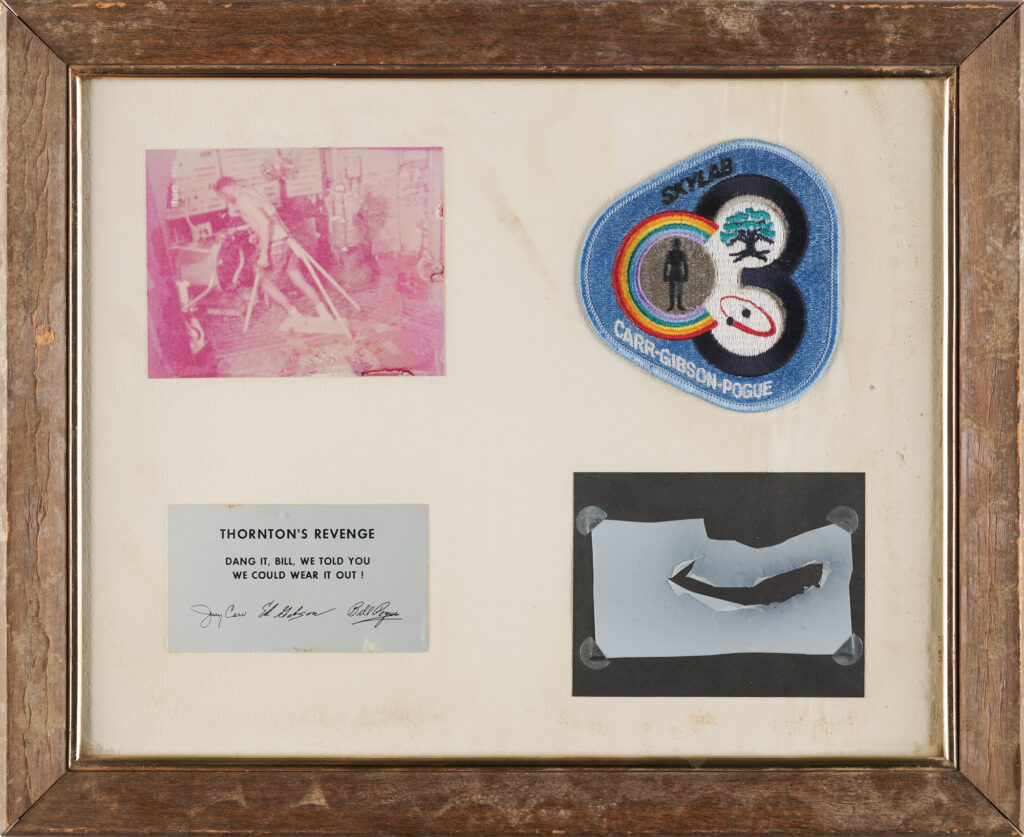
Other Skylab pieces include a flown Skylab II heat shield plug, a charred sample of the material that kept the capsule from burning up on reentry, and a crew-signed photo with all nine Skylab astronauts.
What Does “Attested Flown” Mean?
Medallions have serial numbers and published flown counts. Most other flown items don’t. That’s where “attested flown” comes in. It means the astronaut or their estate states that the item flew. Personal gear and working paperwork rarely came home with a NASA certificate, so a clear line back to the astronaut who used it, plus physical evidence like Velcro on the back (everything in a weightless cabin had to stick to something) and post-flight archive stamps, is often the best documentation that exists. It’s a different standard than a flown Robbins medallion, and a good catalog tells you which is which.
Flown Shuttle Documents: The Working Papers of a Physician-Astronaut
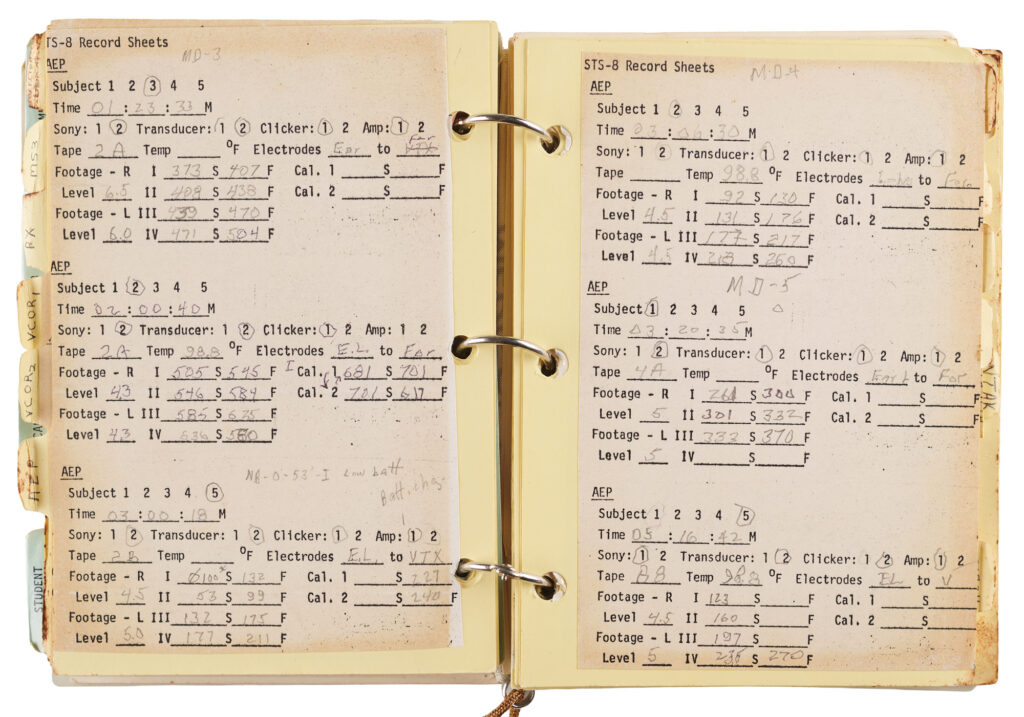
Thornton’s Shuttle material shows what flown documents look like at their best. His STS-8 Medical Checklist runs over 162 pages, with more than 30 pages of handwritten exam data recorded in orbit. A checklist is exactly what it sounds like, the step-by-step book the crew followed, in this case for medical procedures. Flight documents with in-flight handwriting are among the most personal things a mission produces. His STS-51-B “Crew Notes: Thornton” notebook covers seven mission days, treadmill runs, and animal experiments.
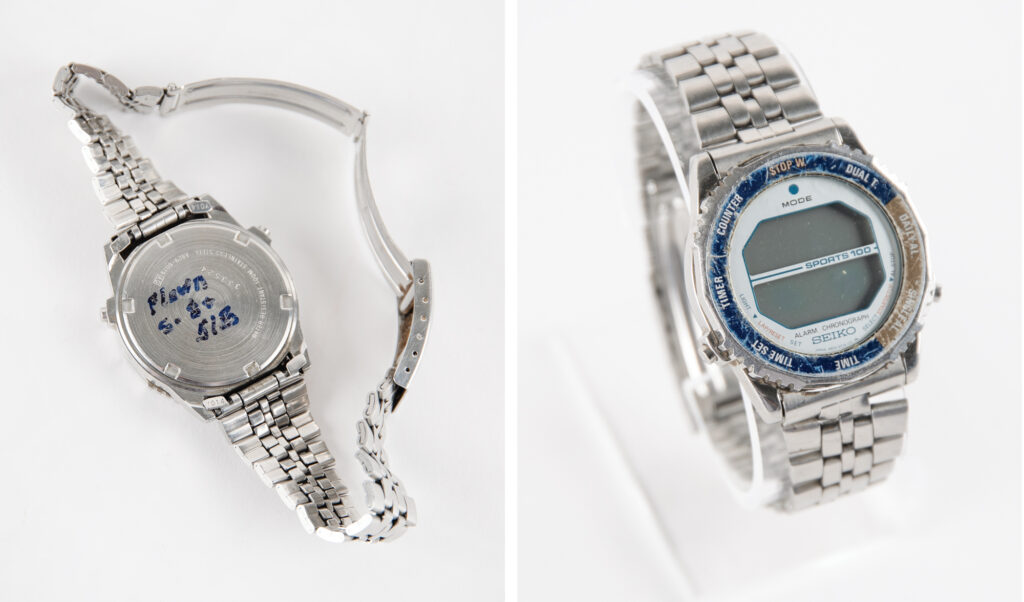
The crown jewel for watch collectors is his twice-flown Seiko A829 “Astronaut” watch, worn on both STS-8 and STS-51-B and annotated on the caseback in his own hand, “Flown S. 8 + 51B.” A NASA photo of Thornton running a biomedical experiment on STS-8, with the watch visible on his wrist, comes with it. That’s the kind of evidence collectors love: the object, and a picture of it in use.
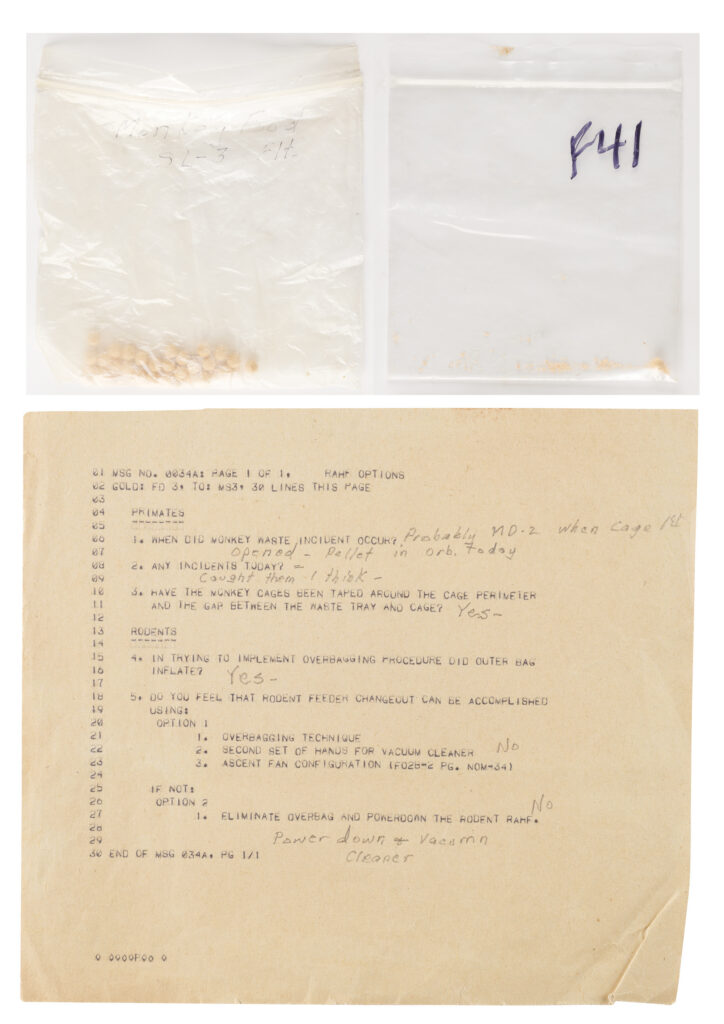
And yes, there are monkey pellets. Spacelab 3 carried two squirrel monkeys and a group of rats, and Thornton was responsible for them. Lot 6424 is a bag of banana-flavored food pellets labeled by Thornton “Monkey Food, SL-3 Flt,” paired with an in-flight teleprinted message asking about a “monkey waste incident.” Space history is not always glamorous.
Other flown paper includes cue cards, the small reference cards crews Velcroed to the cabin walls, and teleprinted messages, which is how Mission Control sent written updates to the crew before email existed. On one CO2 absorber cue card, a crewmember checked off a day with a two-word review: “Freakin A.” There’s also a crew-signed STS-8 flown cover. A cover is a stamped, postmarked envelope. Roughly 260,000 flew on STS-8, but this is one of only ten signed by the full crew.
Personal Pieces: A Snoopy Print, Flight Suits, and a Muscle Car
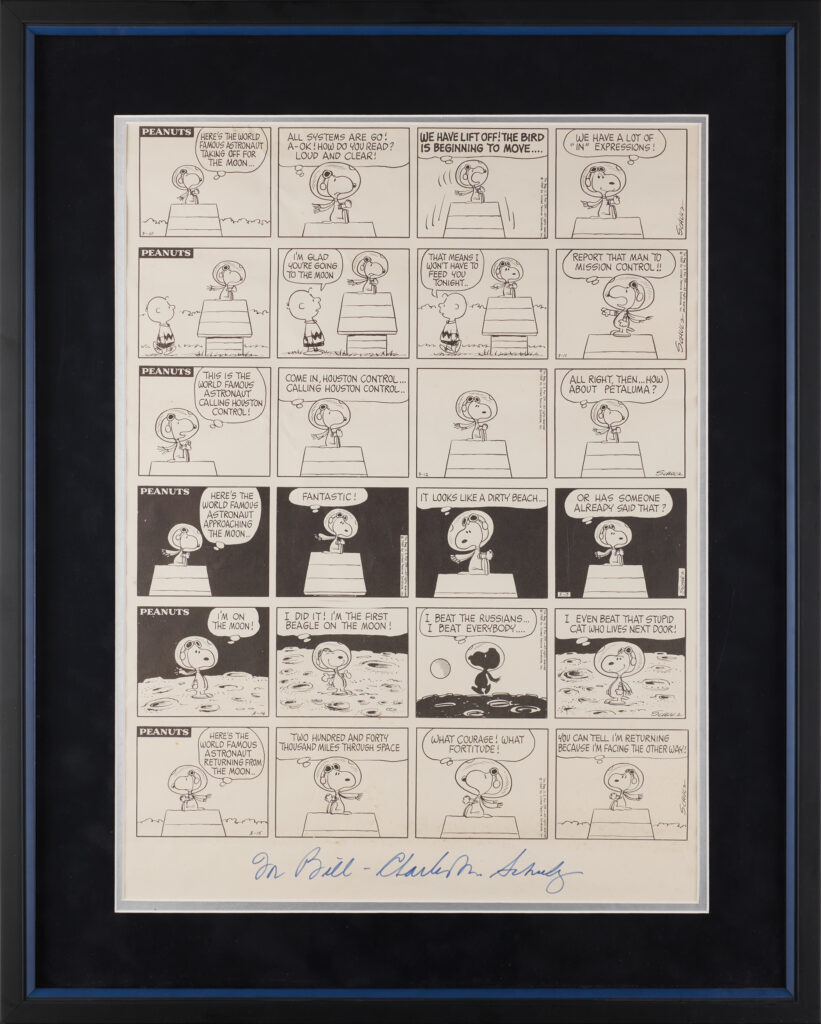
Charles Schulz inscribed a large ‘Astronaut Snoopy’ Peanuts print to Thornton, “For Bill.” Snoopy became NASA’s unofficial safety mascot in the Apollo era, Apollo 10’s lunar module was nicknamed “Snoopy,” and NASA’s Silver Snoopy award still honors people who keep astronauts safe. The Apollo 12 crew, Alan Bean, Pete Conrad, and Dick Gordon, signed a book to him with the line, “You helped make the impossible dream of flying men to the moon a reality.” His Apollo-era “mustard yellow” flight suit still wears his “Bill Thornton, MSC-Houston” name tag (MSC was the Manned Spacecraft Center, renamed Johnson Space Center in 1973).
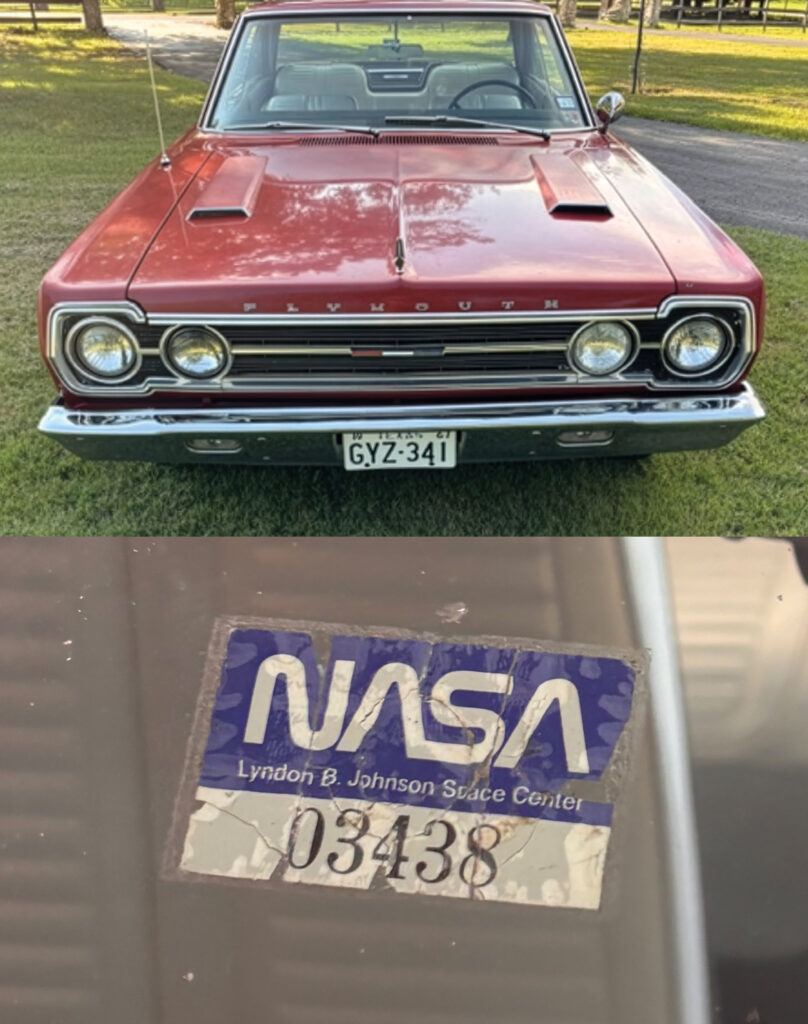
And then there’s the car. Thornton’s 1967 Plymouth Belvedere GTX, a 440 four-speed in Turbine Bronze Metallic, was his daily commute to Johnson Space Center, and it still has its original NASA windshield sticker. According to his son, it once ended up alongside Alan Shepard’s Corvette on NASA Road 1. Neither astronaut was going to lose. They took off from one stoplight after another and arrived with both cars smelling of burned rubber.
Fequently Asked Questions
A sterling silver or gold commemorative medal made by the Robbins Company of Attleboro, Massachusetts, for NASA’s crewed missions beginning with Apollo 7 in 1968. They were ordered through the astronaut corps, a portion flew on each mission, and they were given afterward as personal mementos.
A flown medallion went to space on the mission it commemorates. An unflown one was struck from the same dies but stayed on the ground. Flown examples are far scarcer and generally worth considerably more.
Start with the serial number. On missions where only part of the run flew, the flown medallions carry the low serial numbers, and from Apollo 17 onward flown examples have an “F” next to the serial. Provenance back to an astronaut is the other half of the answer.
Apollo 17. Only 80 flew on the last moon landing mission in 1972, the fewest of any Apollo flight. Apollo 16, with 98 flown, is second.
It means the astronaut or their estate states that the item flew in space. For personal gear and working documents, which rarely came with NASA certificates, that direct provenance is often the best documentation available.
Further Reading
- Space Flown Artifacts: Apollo-era Robbins medallions, the mission-by-mission reference for mintage and flown counts.
- Gene Cernan’s three-time-flown $2 bill, which went to the surface of the moon on Apollo 17 and sold at RR for $91,519.
- Dr. William E. Thornton’s biography and all 60 lots from his collection at RR Auction.
