

“The Essence of the Theory of Relativity”
By Albert Einstein, as published in English within volume XVI of ‘The American Peoples Encyclopedia’
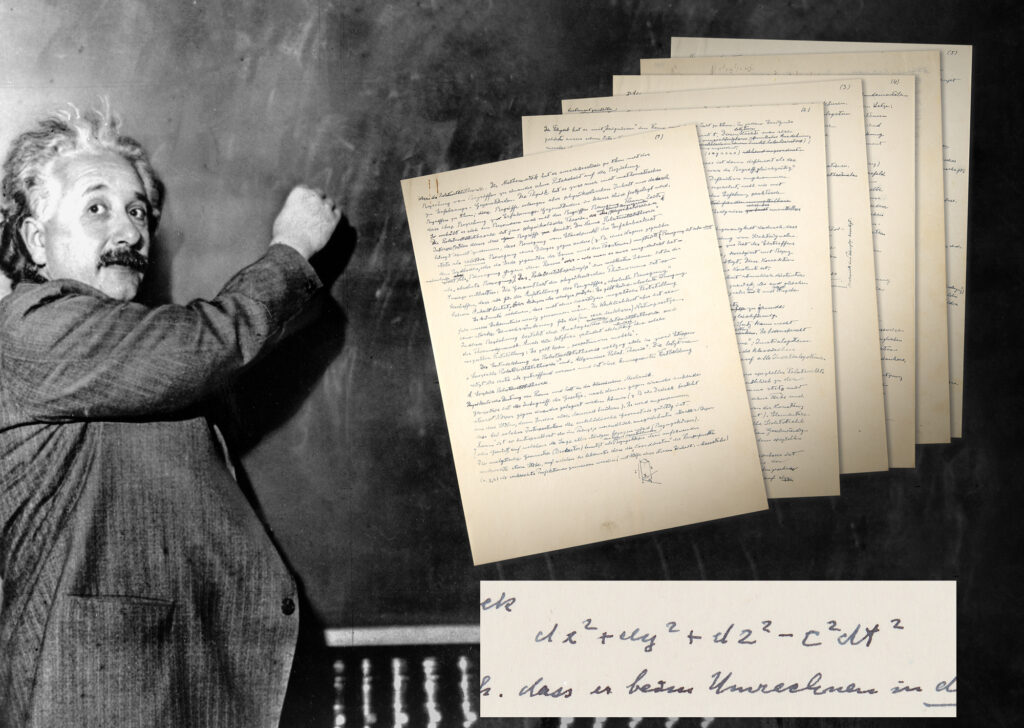
Essence of the Theory of Relativity
Mathematics deals exclusively with the relation of concepts to each other without regard to the relation to objects of experience. Physics also deals with mathematical concepts; but these concepts acquire physical content only due to the fact that their relation to objects of experience is determined in a clear way. This is the case in particular with the concepts of motion, space, time. The theory of relativity is that physical theory, which is based on a consistent physical interpretation of these three terms.
The name ‘theory of relativity’ is due to the fact that motion from the point of view of perceptibility always occurs as relative motion of a thing against others (e.g. a car against the ground, or the earth against the sun and the fixed stars) (however, motion is not perceptible [;] not as ‘motion against space’ or – as it has also been expressed – as ‘absolute motion’). The ‘principle of relativity’ in the broadest sense is contained in the statement: The totality of physical phenomena is such that it offers no support for the establishment of the concept of ‘absolute motion’, or more briefly but less precisely: there is no absolute motion.
It might seem that with such a negative statement little would be gained for our knowledge. But in reality, it is a strong restriction for the (in principle conceivable) laws of nature. In this respect there is an analogy between the theory of relativity and thermodynamics. The latter is equally based on such a negative statement: There is no ‘perpetuum mobile’. The development of the theory of relativity took place in two stages ‘Special Theory of Relativity’ and “General Theory of Relat.”. The latter presupposes the first one as true and is its consequent further development.
Special theory of relativity
Physical interpretation of space and time in classical mechanics.
Geometry is the epitome of the laws according to which rigid bodies at rest against each other can be positioned against each other (e.g. a triangle consists of three edges whose ends touch each other permanently). It is assumed that with such interpretation Euclidean geometry is valid. ‘Space’ is thus interpreted as a rigid body (or framework), in principle infinitely extended, to which the position of all others is referred to (reference body). The analytic geometry (Deckartes [sic!]) uses as the reference body representing the space three rigid staffs perpendicular to each other, on which in known manner the ‘coordinates’ of the points of space (x, y, z) are measured as perpendicular projections (with the help of a rigid unit scale).
Physics deals with ‘events’ in space and in time. Beyond a place-coordinate x, y, z a time-value t belongs every event. The latter is thought to be measurable by a clock (ideal periodic process which is practically localized in a point of negligible spatial extension).
This clock U is thought to be arranged at rest in a point of the coordinate system, e.g. arranged at rest in the coordinate origin (x = y = z = 0).
The time of an event taking place at the point P (x, y, z) is then defined as the indication of the clock U simultaneous with the event. Here the term ‘simultaneous’ was assumed as a physically meaningful term without a particular definition. (This was an inaccuracy which seems harmless only because with the help of light (by virtue of its propagation speed which is practically infinitely large from the point of view of the daily experience) we already seem to have a means to state the simultaneity of spatially distant events directly[)].
This special theory of relativity justifies this inaccuracy by the fact that it defines the simultaneity physically by the use of light signals. The time of the event in P is the indication of the clock U at the time of the arrival of a light ray signal emitted by the event, corrected with reference to the time that the light signal needs for its propagation. This correction presupposes (postulates) that the speed of light is a constant. This definition reduces the notion of simultaneity of spatially distant events to that of simultaneity of events occurring at the same place (coincidence), namely arrival of the light signal at U based on the pointer indication of U.
Classical mechanics are based on Galilei’s principle of inertia: a body moves rectilinearly – uniformly, as long as other bodies do not affect it. This theorem cannot be valid with respect to arbitrarily moving coordinate systems. It claims validity only with respect to so-called ‘inertial systems’ [inertial space]; inertial systems are rectilinear against each other – uniformly moved. In classical physics, the laws claim validity only with respect to all inertial systems. (Special relativity principle).
Now it is easy to understand the dilemma which led to the special theory of relativity. Experience and theory have gradually led to the conviction that light in empty space always propagates with the same velocity c, independent of its color and of the state of motion of the light source (principle of constancy of the velocity of light (hereafter called ‘L-principle’).
Now, elementary descriptive consideration seems to indicate that the same light ray cannot propagate with the same speed with respect to all inertial systems. But it seems that the L-principle contradicts the principle of special relativity.
However, it turns out that this contradiction is only an apparent one and is essentially based on the prejudice of the absolute character of time or the simultaneity of distant events. We have seen above that x, y, z and t of an event can only be initially defined with respect to a chosen coordinate system (i.e. with respect to an inertial system). The conversion of the x, y, z, t of the events, which has to be done at the transition from one inertial system to another (transformation of coordinates), is a problem that cannot be solved without special physical assumptions. For its solution, however, just the postulate is sufficient: the L-principle is valid with respect to all inertial frames. (The application of the principle of special relativity to the L-principle). The so defined transformations, which are linear to x, y, z, t, are called Lorentz transformations. The Lorentz transformations are formally characterized by the fact that the expression formed from the infinitesimal coordinate differences dx, dy, dz, dt of two infinitely neighboring events
dx²+dy²+dz²-c²dt²

is invariant (i.e. that it changes into the same expression formed from the coordinate differences in the new system).
With the help of the Lorentz transformations one can thus express the principle of special relativity: The laws of nature are invariant with respect to Lorentz transformations (i.e. a law of nature does not change its form if x, y, z, t of a new inertial system is introduced into it by means of a Lorentz transformation).
The special theory of relativity has led to a clearer knowledge of the physical concept of space and time and in connection with this, to the knowledge of the behavior of moving scales and clocks. It has eliminated, in principle, the concept of absolute simultaneity and therefore also the remote force in the sense of Newtonian mechanics. It has shown how the law of motion is to be modified, when it concerns movements that are not negligibly small against the speed of light. It has led to a formal clarification of Marwell’s equations of the electromagnetic field, in particular also to the realization of the essential unity of the electric and magnetic fields. It has united the conservation laws of momentum and energy to a single law and has shown the essential unity of carrier mass and energy. From the formal point of view of the general theory of relativity, the achievement of special relativity can be characterized as follows: it has generally shown the role which the universal constant c (speed of light) plays in the laws of nature and has shown that there is a close relationship between the form in which time, on the one hand, and the spatial coordinates, on the other hand, enter into the laws of nature.
General theory of relativity
In one fundamental point the special theory of relativity held on to the basis of the classical mechanics, namely the sentence: the laws of nature are valid only with respect to inertial systems. The ‘allowed’ transformations for the coordinates (i.e. those which leave the form of the laws invariant) and exclusively the (linear) Lorentz transformations. Is this restriction really based on the physical facts? The following argument speaks convincingly against it.
Principle of equivalence
A body has an inertial mass (resistance against acceleration) and a heavy mass (which determines the weight of the body in a given gravitational field, e.g. at the earth’s surface). These two properties, so different in their definition, are, according to experience, measured by exactly the same number. There must be a deeper reason for this. The fact can also be described in this way: in a gravitational field, masses of different kind all experience the same acceleration. Finally, one can also express it such: in a gravitational field all bodies behave in the same way as in the absence of a gravitational field, if, in the latter case, one uses a uniformly accelerated coordinate system (instead of an inertial system) as the system of reference.
In the latter case, there seems to be no reason to forbid the following interpretation. One considers the latter system as ‘resting’ and the ‘apparent’ gravitational field existing with respect to the same as a ‘real’ one. This gravitational field (‘produced’ by acceleration of the coordinate system) would then, however, be of unlimited extension and could therefore not be attributed to gravitating masses located in the finite as causes; if, however, we strive for a field-like theory, this circumstance need not deter us. With this interpretation the inertial system loses its sense and there is an ‘explanation’ for the equality of the heavy and inertial mass (The same quality of matter appears as heaviness or as inertia, depending on the mode of description).
Formally, the admission of a coordinate system relative to the original accelerated one entails the admission of non-linear coordinate transformations, i.e. a tremendous extension of the concept [thought] of invariance, i.e. of the principle of relativity.
At first a detailed discussion based on the results of the special relativity theory shows that with such an extension the coordinates can no longer be interpreted directly as measurement results. Only the coordinate differences together with the field quantities describing the gravitational field determine measurable distances between events. After one finds oneself in principle compelled to use not linear [text appears incomplete in original]
Historical Context and Significance
Written in 1947-48, this article represents Einstein’s attempt to explain his revolutionary theories to the American public in the aftermath of World War II. The atomic bomb had thrust nuclear physics—and Einstein’s famous equation E=mc²—into public consciousness, creating unprecedented demand for accessible explanations of relativity theory.
This manuscript provides unique insight into Einstein’s pedagogical approach, showing how he structured complex scientific concepts for general audiences. Notice how he begins with the most fundamental philosophical distinctions between mathematics and physics, then builds systematically toward the technical details.
