

A Certificate, a Macintosh, and the Way Apple Really Worked
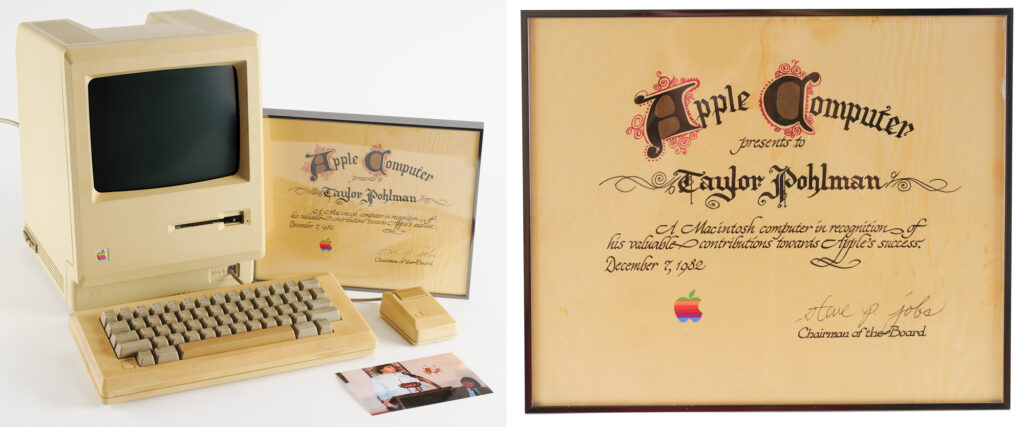
Apple history is often told through products. Machines unveiled on brightly lit stages. Devices that arrive fully formed and destined to change behavior. But if you listen closely to the people who were there, the real story of Apple unfolds in conference rooms, hallways, and moments of creative friction. This artifact, a Steve Jobs signed farewell certificate presented to Taylor Pohlman, comes from that more revealing layer of Apple’s past.
Pohlman joined Apple Computer in 1979 as employee number 400, when the company was still small enough to feel like a single, argumentative organism. Engineers from Intel. People oriented managers from HP. Hard driving veterans from National Semiconductor. The mix was volatile but productive. Conflict was not avoided. It was expected.
By the early 1980s, Pohlman had become product marketing manager for the Apple II and Apple III lines, overseeing the machines that were doing the unglamorous but essential work of funding Apple’s future. The Apple II was not merely successful. It was the engine. It generated the revenue that allowed Apple to experiment with Lisa and, ultimately, Macintosh.
That mattered deeply to Pohlman. It mattered less to Steve Jobs.
Jobs was never particularly interested in maintaining the present. He was interested in escaping it. Once Macintosh became his obsession, the Apple II represented something he instinctively resisted. Continuity. Jobs believed that companies, like cathedrals, were often built by dismantling what came before and reusing the stones.
Working for Jobs, Pohlman later said, felt like riding backwards on a roller coaster. The pace was thrilling. The direction was not always clear. Jobs pushed people to do the impossible and rarely paused to worry about how that pressure landed.
By late 1982, the tension between them had become structural rather than personal. Jobs was moving forward at full speed toward Macintosh. Pohlman believed Apple still needed to invest in the products that were paying the bills. He also believed, crucially, that software, not hardware, was the future.
So he left.
His resignation letter was direct enough that it circulated inside Apple. People noticed. This was not just another employee departing. It was someone responsible for the company’s economic backbone. Jobs noticed too. He called Pohlman. They talked. They shared wine. And then something very Apple happened.
Pohlman’s colleagues decided to throw him a roast.
This was not a formal corporate sendoff. It was loud, affectionate, and theatrical, an internal tradition borrowed from the sales floor. More than 200 people showed up. And someone invited Jobs.
Jobs came.

At the end of the evening, Jobs stood up with a hand painted certificate and read it aloud. It declared that Apple Computer was presenting Taylor Pohlman with a Macintosh computer in recognition of his valuable contributions toward Apple’s success. Jobs signed it boldly, “steve p. jobs,” as Chairman of the Board, beside a rainbow Apple logo.
In December 1982, the Macintosh did not yet exist.
The certificate functioned as a promise. But it was also something more revealing. Jobs was acknowledging Pohlman’s role in getting Apple to the point where Macintosh could happen, even as he pushed past the product that made it possible.
When the Macintosh finally shipped in early 1984, Pohlman presented the certificate to Jobs’ assistant. Jobs, she explained, had already moved on. That was typical. Pohlman calmly replied that if anyone had been promised a Macintosh earlier than December 1982, he would gladly wait behind them.
He did not have to wait long.
He received the Macintosh, and he kept the certificate. The computer went on to live a practical life, even being used by his daughter for school. The certificate stayed with him, quietly preserved, along with photographs and video footage documenting the moment it was presented.
That last detail matters.
Steve Jobs did not sign everything. He was selective. He understood symbolism. Signed Apple documents are rare. Signed in house awards are rarer. Video footage showing Jobs personally presenting a signed artifact to an employee is rarer still. From a provenance standpoint, this represents an extraordinary convergence. The object is not simply signed. It is witnessed, contextualized, and recorded at the moment it was given.
After leaving Apple, Pohlman co founded Forethought, a software company built around the Macintosh interface and object oriented design. One of its projects, initially called Presenter, became PowerPoint. Microsoft acquired the company in 1987, recognizing that a new category had been created and wanting the product that defined it.
That trajectory, from Apple hardware to software, from internal conflict to industry shaping impact, makes this artifact more than a collectible. It is a primary source document of how Apple actually worked. Brilliant. Argumentative. Unsentimental. And occasionally generous in surprising ways.
This certificate was never meant for the public. It was created for a single night, a single person, and a moment when Apple was shedding one version of itself in order to become another.
That is why it endures.
Not simply because it bears Steve Jobs’ signature, but because it captures something far harder to preserve. The culture that made Apple Apple, before the mythology set in, preserved with a level of provenance that is exceptionally rare, even by Apple’s standards.
