
The “Celebration” Apple-1: The Board That Nearly Bankrupted Steve Jobs—and Saved Apple
Imagine you’ve sold your Volkswagen bus—your only means of transportation—to raise money for a business venture. Your partner has sold his prized HP-65 calculator. You’ve scraped together $500 and written Check #1 from your brand-new bank account to pay for the design work. Sixteen days later, you’ll officially found your company.
Then the validation board arrives from the manufacturer. Board Zero. The one board you ordered to test whether your corrected design actually works.
And it doesn’t work.
This is the story of the “Celebration” Apple-1—Board Zero—the earliest known fiberglass Apple-1 prototype, and arguably the most consequential circuit board in computing history. It’s the board that nearly cost Steve Jobs everything, and the board that made Apple Computer possible.
March 1976: Everything on the Line
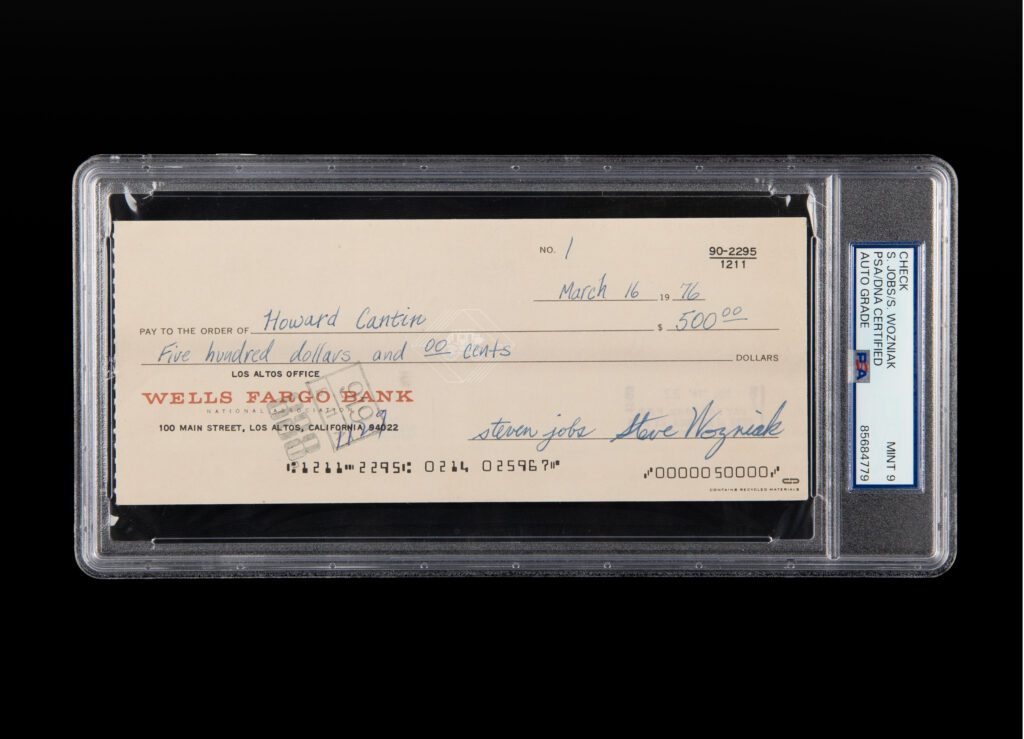
On March 16, 1976, Steve Jobs and Steve Wozniak wrote their first check—a temporary Wells Fargo check numbered “1”—payable to Howard Cantin for $500. Both signed it, as required by their partnership agreement for any expenditure over $100. This wasn’t corporate money. This was everything they had.
In his autobiography iWoz, Wozniak recounts their desperation:
“To come up with the $1,000 we thought we’d need to build ready-made printed circuit boards, I sold my HP 65 calculator for $500. The guy who bought it only paid me half, though, and never paid me the rest…And Steve sold his VW van for another few hundred dollars. He figured he could ride around on his bicycle if he had to. That was it. We were in business.”
Steve Wozniak
They weren’t just betting on an idea. They were betting everything they owned.
Cantin’s task was to translate Wozniak’s schematic into a manufacturable PCB layout for the Apple-1. The first attempt—a tan phenolic prototype board that RR Auction sold in August 2022—was an inexpensive test board that required extensive reworking to function. It revealed the problems in the design.
Now Jobs and Wozniak needed to know: would the corrected design work when produced on a proper fiberglass PCB? They ordered a single validation board—Board Zero—to test before committing to a production run.
The Board That Didn’t Work
The board arrived. Board Zero. The validation unit. Jobs and Wozniak had invested everything. They had Check #1 cashed and a bank statement showing their meager $500 deposit—and immediate deduction.
Everything hinged on testing this one board.
According to Apple historian Corey Cohen—one of the world’s foremost Apple-1 experts—who examined the “Celebration” board extensively, what happened next nearly ended Apple before it began:
“They sold a lot of their possessions so they could get these green fiberglass boards made,” Cohen explains. “And they didn’t work.”
They assembled Board Zero. They tested it. It didn’t work.
The pressure fell on Steve Jobs. Wozniak was still working full-time at HP—unavailable for the painstaking troubleshooting this failure demanded. Jobs, with everything to lose and no one else to turn to, had to fix it himself.
But Jobs wasn’t flailing in desperation. He knew his way around a soldering iron. At Atari, where he’d worked as a technician, Jobs had spent countless hours doing exactly this kind of work—troubleshooting circuit boards, soldering components, diagnosing failures. Now, those hard-earned skills would determine whether Apple Computer lived or died.
Today we think of Steve Jobs as the visionary, the marketer, the CEO. But in March 1976, with Wozniak tied up at HP and everything on the line, Jobs almost certainly was the one bending over this green fiberglass board with a soldering iron, methodically testing, modifying, and troubleshooting until he isolated the problem. This wasn’t just determination—it was technical skill under immense pressure.
“If he didn’t,” Cohen says, “there’d be no Apple Computer. As a matter of fact, he would have lost everything that he owned.”
The Expert’s Authentication
Cohen’s evaluation of the “Celebration” Apple-1 carries significant weight. Widely regarded as the leading authority on the Apple-1, Cohen is a co-founder and board member of the Vintage Computer Federation. He has examined nearly every Apple-1 known to exist and has worked with major museums to present functional historic systems.
RR Auction has relied on Cohen’s expertise for its industry-leading Apple-1 sales, including the groundbreaking 2022 sale of the tan phenolic prototype. His determination that the “Celebration” board is indeed Board Zero—the pre-production validation unit—is based on exhaustive technical analysis. While some conflicting information exists in the vintage computing community, Cohen’s authentication settles the question: this is the prototype that preceded production.
Steve Jobs’s Only Electronic Signature
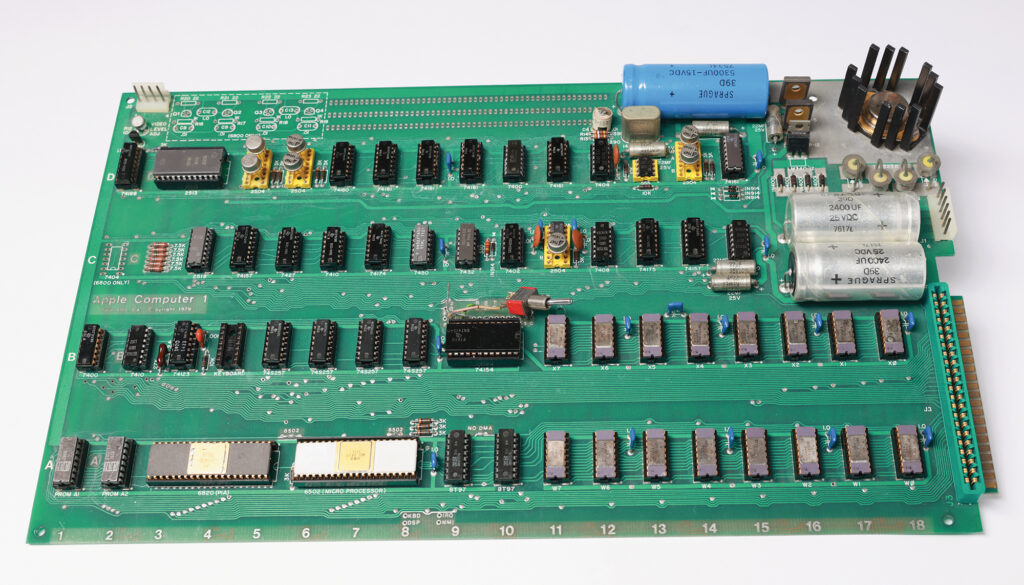
Turn the “Celebration” Apple-1 over, and you see something remarkable: extensive hand-soldering that almost certainly represents Steve Jobs’s own work. With Wozniak holding down a full-time job at HP and unavailable for the intensive troubleshooting required, Jobs—armed with his Atari training and facing the loss of everything—was the only one who could have made this board work.
Production Apple-1 boards were wave-soldered by machine, with only minimal hand-soldering for final components. But the “Celebration” board tells a different story. Only the Robinson-Nugent sockets—higher-quality sockets than the Texas Instruments ones used in production—were machine-soldered. Everything else was done by hand.
“This is probably,” Cohen observes, “Jobs’s only signature of his work in electronics for any Apple product ever.”
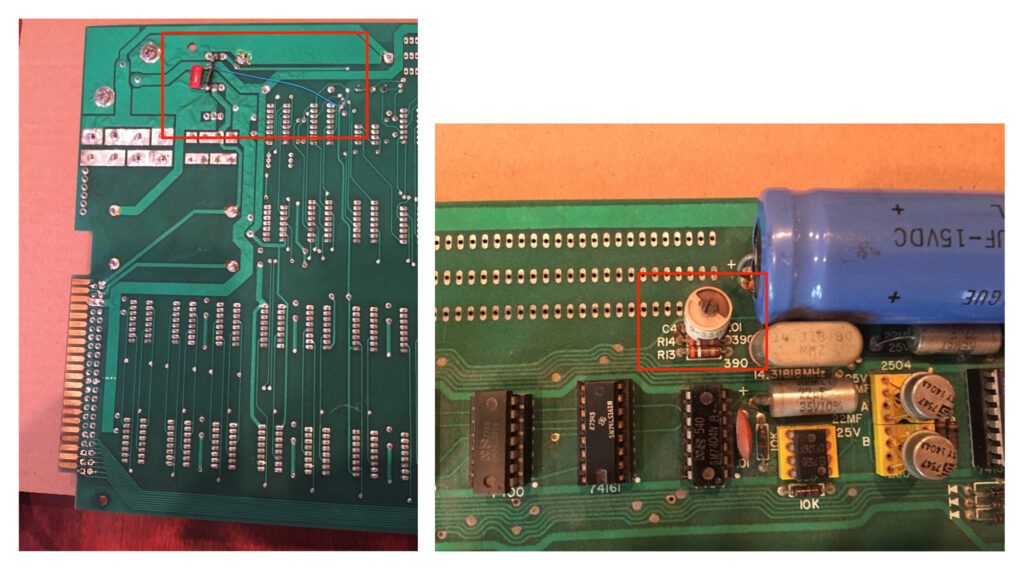
The board’s unique characteristics document what was almost certainly Jobs’s troubleshooting work:
- Hand-soldered local components: Two silver Sprague 39D capacitors that weren’t computer-rated but were easily available at a radio repair shop—evidence of rushed, resourceful sourcing
- Unique 74123 timing circuit modification: A fix to the DRAM refresh timing, showing the diagnosis and correction of issues before production
- Non-standard heatsink configuration: A smaller heatsink with no evidence the production-style version was ever intended
These aren’t the marks of a retail product. These are the marks of a skilled technician fighting for survival—applying every trick learned at Atari to prove a design worked before the money ran out.
Board Zero: The Validation That Saved Everything
Jobs got it working.
This simple green fiberglass board, the size of a sheet of legal paper, became the proof that the corrected Apple-1 design was manufacturable. With Board Zero functioning, Jobs and Wozniak could confidently move forward with production. They could become a computer company.
“Without this board,” Cohen emphasizes, “there would be no production run. There’d be no Apple One computers. As a matter of fact, there’d be no Apple.”
The “Celebration” Apple-1 occupies a unique place in history. It predates all Byte Shop boards. It was never intended for retail sale. It embodies the moment of Apple’s transition from garage experiment to commercial product—the moment theory became reality.
A Connected Story Across Three Lots
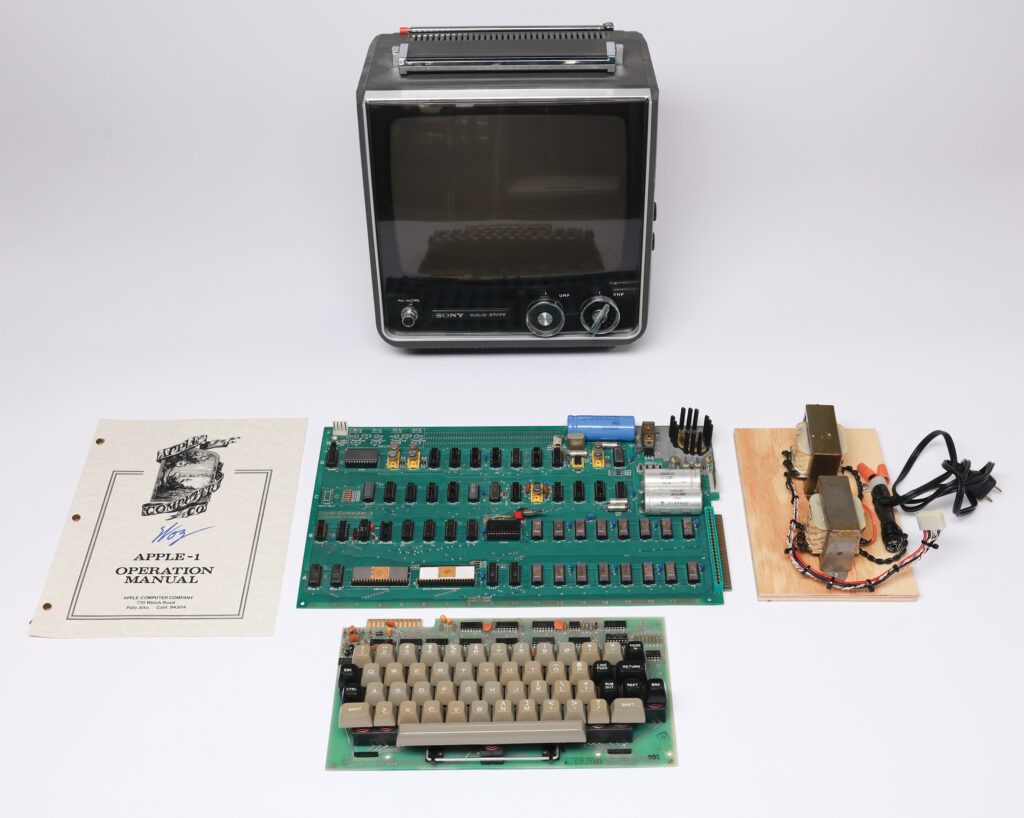
RR Auction has assembled a remarkable trifecta of artifacts documenting Apple’s founding moment:
Lot #6000: Check #1 – The first check ever drawn on Apple’s bank account, signed by both Jobs and Wozniak, paying Howard Cantin for the PCB design work. Dated March 16, 1976—sixteen days before Apple Computer, Inc. officially existed.
Lot #6002: The First Bank Statement – Documenting the $500 deposit and the corresponding $500 deduction when Check #1 was cashed on March 23rd.
Lot #6003: The “Celebration” Apple-1 – The board that justified those sacrifices. The board that almost didn’t work. The board that saved everything.
Together, these artifacts tell a complete story: the moment two young engineers bet everything they owned on a vision, nearly lost it all when the prototype failed, and through technical skill and determination, launched the personal computer revolution.
RR Auction’s Unparalleled Apple-1 Legacy
RR Auction has established itself as the premier destination for Apple-1 computers and early Apple artifacts, having sold more Apple-1 computers than any other auction house. The 2022 sale of the tan phenolic prototype—the inexpensive test board that preceded the “Celebration” board—demonstrated RR Auction’s unique access to the most historically significant artifacts from Apple’s genesis.
That phenolic prototype revealed the problems. The “Celebration” board proved the solutions worked. Together, they document the complete evolution from experimental concept to manufacturable product.
The Most Important Production Board Run Ever
Only about 200 Apple-1 computers were ever made, and fewer than 80 are known to exist today. But the “Celebration” Apple-1 stands apart from all of them. It isn’t one of the 200—it’s the board that made the 200 possible.
As Corey Cohen puts it, this represents “the most important production board run ever.” It’s the physical evidence of a make-or-break moment when Steve Jobs—almost certainly armed with skills from Atari and everything to lose—had to make a failed prototype work or lose it all.
For collectors and institutions, this represents more than a once-in-a-lifetime opportunity. It’s a chance to own the moment when Apple Computer was born.
The “Celebration” Apple-1 is being offered by RR Auction as Lot #6003. Related lots include Lot #6000 (Apple Computer’s first check to Howard Cantin) and Lot #6002 (Apple Computer’s first bank statement). For more information or to register to bid, visit www.rrauction.com.
RR Auction specializes in rare and remarkable autographs, artifacts, and memorabilia. The auction house has established itself as the world’s leading marketplace for Apple-1 computers and early computing history.
